
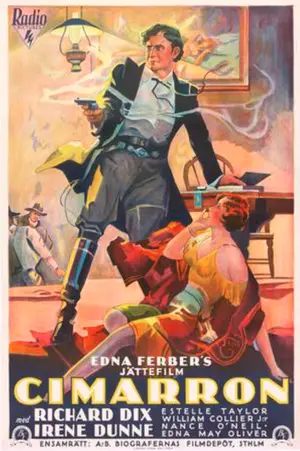
True Grit Rating: Cimarron
Loading the ticket…
Cimarron (1931) is a pre-Code epic Western adapted from Edna Ferber's 1930 novel, starring Richard Dix and Irene Dunne. It was the first Western to win the Academy Award for Best Picture.
Cast

If you liked this
Picked from this wiki's own links: same film series, same director, same lead actor.


Frontier folk
This film is listed on: Doctors, schoolteachers, newspaper editors and shopkeepers (all Frontier folk)
Key facts
- Directed by Wesley Ruggles
- Released 1931
Gallery 3



True Grit RatingWhat's this?Woke: None foundIMDb ★5.8Partly checked
True Grit score: 99/100, Gold Partly checked
How the score is worked out:
- Start100
- Diamond needs all five checks; not met (raw score under 109; IMDb under 7.0 or under 10,000 votes; content guide not complete): 100 → 99
- True Grit score99 · Gold
Classic Western checks
0 of 5 yes · Classic Western
- Called “revisionist”NoNo: described as a conventional Western, not a revisionist one.[1]
- Settlers or cavalry as villainsNoThe villains are outlaws, Lon Yountis and the gang led by The Kid. [2][1]
more
The villains are outlaws, Lon Yountis and the gang led by The Kid. For a time Sabra is vehemently anti-Native American, but years later she praises her daughter-in-law, and Yancey supports the tribes in his newspaper. - Faith shown negativelyNoThe plot shows no clergy or faith portrayed negatively.[2]
- History rewrittenNoNo: an invented story set among real people or events; it does not claim to be a true story.[2][1]
- A people shown as villainsNoNo: no ethnic, national or religious people is cast as the enemy as a group; the villains are individuals.[3][1]
Woke content (modern messaging)
None found0 of 8 items found so far
Show all 8 (3 not found · 5 not known)
Unless noted: Unknown.
- Characters recast for representationNot foundBased on Edna Ferber’s novel of the same name, whose Yancey and Sabra Cravat are played by Richard Dix and Irene Dunne, with no change of …[2][4]
- Gender roles reversed or critiquedNot known
- Present-day political languageNot known
- Allegory for current politicsNot foundReleased in 1931, before the 21st-century debates this item covers, so it cannot be an allegory of them.[2]
- Western civilisation framed as inherently guiltyNot known
- Environmental activismNot foundNo: no source raises an environmental message (5 Nov 2026).[2]
- Source material changed for messagingNot known
- LGBT or gender-identity themesNot known
Audience
★ 5.8/10 from viewers on IMDb (8k votes)No deduction (5.0 and up).
Sources
- Grokipedia: Cimarron (checked 18 October 2026)
- Wikipedia: Cimarron (plot) (checked 18 October 2026)
- Once Upon a Time in a Western (July)
- The New Yorker, review of the novel (22 Mar 1930)
Information courtesy of IMDb (https://www.imdb.com). IMDb rating as of 13 October 2026.
Checked 18 October 2026 · Reviewed by Frontier Editor
Partly checked: 4 checks not known. Not known items are left out of the score.
Member reviews
What members think. Member reviews never change the True Grit score. The True Grit score is worked out by the editors from sources.
Sources
- Cimarron (1931 film) - Wikipedia en.wikipedia.org
- Wikidata: Q251997 wikidata.org
- Wikimedia Commons: 1931 - Embassy and Strand Theaters Ad - 1 Mar MC - Allentown PA.jpg commons.wikimedia.org
- Cimarron film by Ruggles - Britannica britannica.com
- IMDb Non-Commercial Datasets developer.imdb.com
- Cimarron q29sbgvjdglvbjpwwc0yntyznji - bbfc.co.uk bbfc.co.uk
- Rotten Tomatoes (score via Wikidata) rottentomatoes.com
- Wikimedia Commons: Irene Dunne on a penny-farthing.jpg commons.wikimedia.org
- Wikimedia Commons: Cimarron 1931 Swedish Film Poster.png commons.wikimedia.org
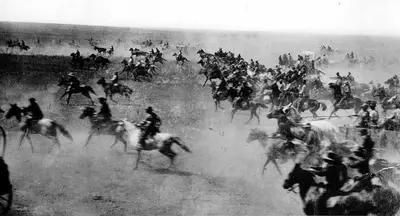
- Wikimedia Commons: Oklahoma Land Rush.jpg commons.wikimedia.org