
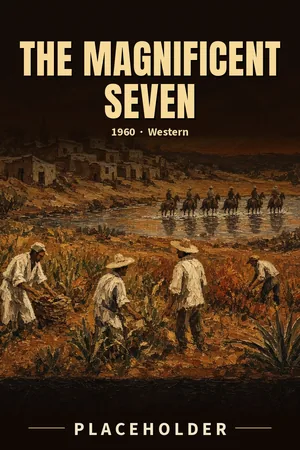

True Grit Rating: The Magnificent Seven
Loading the ticket…
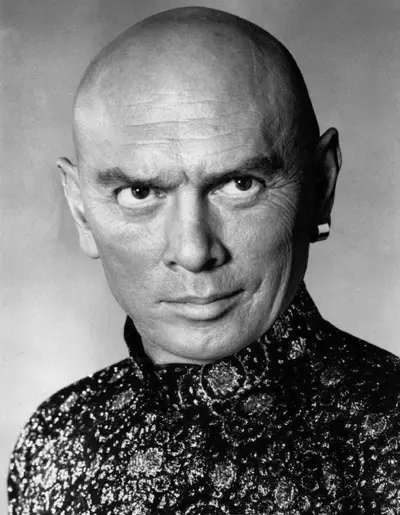
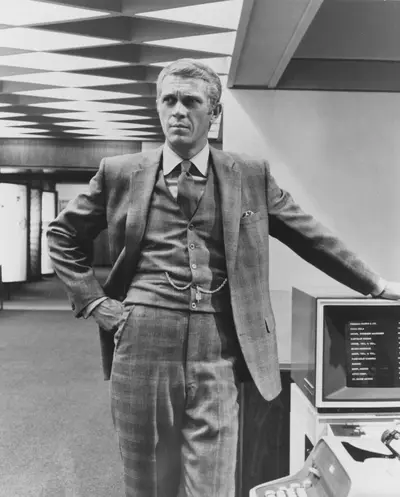
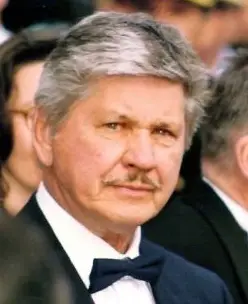
The Magnificent Seven is a 1960 American Western directed by John Sturges. It moves Akira Kurosawa's Japanese epic Seven Samurai (1954) to the Old West: seven gunfighters are hired to defend a poor Mexican village from a gang of bandits led by Calvera, played by Eli Wallach. The seven are played by Yul Brynner, Steve McQueen, Horst Buchholz, Charles Bronson, Robert Vaughn, Brad Dexter and James Coburn. Released by United Artists on 12 October 1960, it is one of the most popular Westerns ever made, and Elmer Bernstein's score is among the most famous in film history. It was added to the National Film Registry in 2013.
Plot
Every year Calvera and his forty bandits ride down on a Mexican farming village and take its harvest. After he kills a villager, the village elder tells the farmers to fight back. Three of them cross the border to buy guns and meet Chris Adams (Brynner), a gunman dressed in black who has just shown his courage by driving a hearse up to Boot Hill in the face of hostile townsmen, so that a dead Indian can be buried there. Chris tells them that "men are cheaper than guns" and agrees to find fighters for them, though the pay is only food and twenty dollars.
He gathers a band of men down on their luck: the drifter Vin (McQueen); his old friend Harry Luck (Dexter), sure there must be gold in it somewhere; Bernardo O'Reilly (Bronson), who is broke; Britt (Coburn), a silent knife expert who comes only for the challenge; and Lee (Vaughn), a well-dressed gunman secretly haunted by fear. Chico (Buchholz), a hot-headed young farmer's son eager to prove himself, trails them until Chris lets him join.
In the village the seven train the farmers, build defences and come to care for the people they are protecting, especially the children, who adopt Bernardo. They beat off Calvera's first attack. But some villagers are afraid of what will happen when the bandits return, and the seven must decide whether to keep faith with people who may not keep faith with them. The answer leads to a final battle in the village street, and not all of them ride away.
Production
Brynner and the producer Walter Mirisch bought the remake rights and set the film up at United Artists. Anthony Quinn, who had earlier been involved, sued Brynner, claiming the idea had been theirs together; he lost because nothing had been put in writing. The script went through several hands. Walter Bernstein wrote a first draft close to the Japanese original, Walter Newman wrote most of what reached the screen, and William Roberts made changes on location partly to satisfy the Mexican censors; Roberts received the sole credit. The title came from the name under which Seven Samurai had first been released in the United States.
McQueen was tied to his television series Wanted Dead or Alive. To get free, he staged a minor car crash and claimed a whiplash injury, and was released to make the film. Coburn, who had seen Seven Samurai many times as a student, won the part of Britt on the recommendation of his old classmate Vaughn. Location shooting began on 1 March 1960 in Mexico, around Cuernavaca, Durango and Tepoztlán, with interiors at the Estudios Churubusco; both the village and the American border town were built for the film. Charles Lang photographed it in Panavision. On set McQueen famously tried to upstage Brynner, fiddling with his hat or his shotgun shells during the star's scenes.
Music
Elmer Bernstein's galloping main theme is one of the best-known pieces of film music ever written. The score was nominated for the Academy Award, losing to Exodus, and in 2005 the American Film Institute ranked it eighth among the greatest American film scores. The theme was later used for many years in Marlboro cigarette advertisements and has been quoted endlessly in films, television and sport.
Reception
The film did only moderately well in the United States but was a huge hit in Europe, where it more than made up the difference; it was the second-biggest film of 1961 at the British box office. In the Soviet Union it sold some 67 million tickets, one of the most successful Hollywood films ever shown there. Reviews were mixed. Some critics found it a pale copy of Kurosawa, and others thought the last third too long. Kurosawa himself reportedly admired it enough to present Sturges with a sword. Its reputation has grown steadily since, helped by its cast, several of whom became great stars, and by the music. Its picture of brave, imperfect men who give their lives for strangers who cannot repay them has kept it a favourite for more than sixty years.
Legacy
Brynner returned as Chris in Return of the Seven (1966), the only member of the cast to come back. George Kennedy took the role in Guns of the Magnificent Seven (1969) and Lee Van Cleef in The Magnificent Seven Ride! (1972); none matched the original. A television series ran from 1998 to 2000, with Vaughn in a recurring role, and Antoine Fuqua directed a remake, The Magnificent Seven (2016).
Key facts
- Released: 12 October 1960
- Director and producer: John Sturges
- Screenplay: William Roberts (credited); Walter Newman and Walter Bernstein (uncredited)
- Based on: Seven Samurai (1954) by Akira Kurosawa
- Music: Elmer Bernstein
- Cinematography: Charles Lang
- Filmed in: Mexico (Cuernavaca, Durango, Tepoztlán)
- Running time: 128 minutes
- Distributor: United Artists
- National Film Registry: 2013
- Directed by John Sturges
- Released 1960
- Remake of Seven Samurai (1954)
- Ensemble cast includes Yul Brynner and Steve McQueen
Cast
See also
If you liked this
Picked from this wiki's own links: same film series, same director, same lead actor.


Frontier folk
This film is listed on: Comancheros and bandit gangs · Hired guns and range bullies · Homesteaders, settlers and wagon-train families · The lone gunfighter (all Frontier folk)
True Grit RatingWhat's this?Woke: None found★★★★★SVLIMDb ★7.7
True Grit score: 99/100, Gold
How the score is worked out:
- Start100
- Traditional values: 2 stars+6
- Kept within 0–100 (was 106)
- Diamond needs all five checks; not met (raw score under 109): 100 → 99
- True Grit score99 · Gold
Classic Western checks
0 of 5 yes · Classic Western
- Called “revisionist”NoNo: a review describes it as a routine, standard, conventional, old-fashioned or traditional Western.[1]
- Settlers or cavalry as villainsNoThe villain is the bandit Calvera and his gang.[2]
- Faith shown negativelyNoThe plot shows no clergy or faith portrayed negatively.[3]
- History rewrittenNoFiction with invented characters; it portrays no real historical events or people, so nothing documented is rewritten. [2]
more
Fiction with invented characters; it portrays no real historical events or people, so nothing documented is rewritten. A remake of Seven Samurai. - A people shown as villainsNoNo: the plot source pins the villainy on named individuals or a specific band, not on a people as a whole.[4]
Woke content (modern messaging)
None found0 of 8 items found so far
Show all 8 (2 not found · 6 not known)
Unless noted: Unknown.
- Characters recast for representationNot known
- Gender roles reversed or critiquedNot known
- Present-day political languageNot known
- Allegory for current politicsNot foundReleased in 1960, before the 21st-century debates this item covers, so it cannot be an allegory of them.[3]
- Western civilisation framed as inherently guiltyNot known
- Environmental activismNot foundNo: no source raises an environmental message (5 Nov 2026).[3]
- Source material changed for messagingNot known
- LGBT or gender-identity themesNot known
Traditional values
★★★★★2/5[2]
From one parents' guide's positive messages and role models ratings: positive messages very little (1) and positive role models a little (2); average 1.5 …
Content guide
- SSex & nudityNoneNone (rated 0/5 in one parents' guide).[2]
- Sexual violence or threatNone[5]
- VViolenceStrongStrong violence and scariness (5/5 in one parents' guide).[2]
- LLanguageNoneNone: one parents' guide rates it not present and says the language is clean.[2]
UK classification advice lists no sex or nudity issues.
Certificates: BBFC PG FSK FSK 12
NoneMildModerateStrongNot known
Audience
★ 7.7/10 from viewers on IMDb (112k votes)No deduction (5.0 and up).
Sources
Information courtesy of IMDb (https://www.imdb.com). IMDb rating as of 13 October 2026.
Checked 17 October 2026 · Reviewed by Frontier Editor
Member reviews
What members think. Member reviews never change the True Grit score. The True Grit score is worked out by the editors from sources.
Sources
- The Magnificent Seven - Wikipedia en.wikipedia.org
- Wikidata: Q19069 wikidata.org
- Wikimedia Commons: The Magnificent Seven (1960 poster).jpg commons.wikimedia.org
- Wikimedia Commons: The Magnificent Seven cast publicity photo.jpg commons.wikimedia.org
- The Magnificent Seven - Britannica britannica.com
- IMDb Non-Commercial Datasets developer.imdb.com
- The magnificent seven q29sbgvjdglvbjpwwc0ynji3mjy - bbfc.co.uk bbfc.co.uk
- Metacritic (score via Wikidata) metacritic.com
- Rotten Tomatoes (score via Wikidata) rottentomatoes.com
- Wikimedia Commons: Kinema-Junpo-1961-May-early-1.jpg commons.wikimedia.org
- Wikimedia Commons: Kinema-Junpo-1961-May-early-2.jpg commons.wikimedia.org
- Wikimedia Commons: Publicity press photo of Yul Brynner in 1960 (cropped) (cropped).jpg commons.wikimedia.org
- Wikimedia Commons: Publicity press photo of Yul Brynner in 1960 (cropped).jpg commons.wikimedia.org
- Wikimedia Commons: Publicity press photo of Yul Brynner in 1960.jpg commons.wikimedia.org
- Wikimedia Commons: Rosenda Monteros The Magnificent Seven (1960).jpg commons.wikimedia.org
- Wikimedia Commons: Rosenda Monteros and Yul Brynner in The Magnificent Seven (1960).jpg commons.wikimedia.org
- Wikimedia Commons: Rosenda Monteros in The Magnificent Seven (1960).jpg commons.wikimedia.org


