
Remington Rolling Block rifle
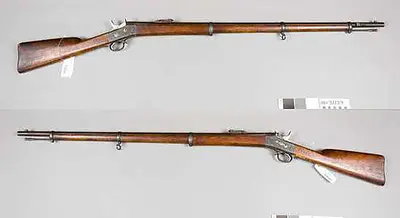
The Remington Rolling Block is a family of single-shot, breech-loading rifles and carbines made by E. Remington & Sons, later Remington Arms, from the mid-1860s into the early twentieth century. Its simple and immensely strong action made it one of the most successful military rifles of its age, adopted by armies from Scandinavia to South America and Egypt. On the American plains it shared with the Sharps the honour of being the buffalo hunter's favourite rifle.
The action
The rolling-block system grew out of a split-breech carbine that Remington supplied to Union cavalry late in the Civil War, and the Remington engineer Joseph Rider refined it in 1864–65. The breech is closed by a rounded block that pivots on a heavy pin. The shooter cocks the hammer, rolls the block back with his thumb to open the breech, inserts a cartridge and rolls the block shut. When the hammer falls, it locks the block firmly behind the cartridge. There were few parts to break, the gun was easy to clean, and a trained soldier could fire quickly with it.
Around the world
Sweden and Norway adopted the Rolling Block as their standard service rifle in 1867, followed the same year by Denmark, and large numbers were made under licence in Scandinavian factories. Spain, Argentina, Mexico and Egypt bought it in quantity; Egypt alone took around a quarter of a million rifles and carbines. France bought Remingtons to make up a shortage during the Franco-Prussian War, and during the First World War the Royal Navy issued rolling blocks to minesweeper and Q-ship crews. In the United States, the Navy and Army also made versions under licence at the Springfield Armory, although the Army settled on the trapdoor Springfield Model 1873 as its main rifle.
Buffalo rifle and target rifle
In the 1870s and early 1880s professional hunters slaughtered the great bison herds of the plains. The Sharps and the Rolling Block were the two rifles most often in their hands, prized for their power and long-range accuracy in calibres such as .50-70 and .45-70. The Rolling Block also had a celebrated moment in target shooting: in 1874, at the new Creedmoor range on Long Island, an American team using Remington and Sharps long-range rifles beat a visiting Irish team in a celebrated international long-range match.
Later years
Military Rolling Blocks were later made in smokeless calibres such as 7 mm Mauser, though some early actions did not cope well with the higher pressures. Surplus rifles became favourite moose guns among Scandinavian hunters, and today reproductions are popular with black-powder target shooters.
Key facts
- Maker: E. Remington & Sons (later Remington Arms)
- Action: single-shot rolling breechblock
- Developed by: Joseph Rider, 1864–65
- Production: mid-1860s to early 1900s
- Calibres: many, including .50-70, .45-70, .43 Spanish and 7 mm Mauser
- First national adopters: Sweden–Norway and Denmark, 1867
- Instance of: weapon model (Wikidata P31)
See also
Seen in
- Lonesome Dove (1989)
Gallery 1

Sources
- Remington Rolling Block rifle - Wikipedia en.wikipedia.org
- Wikidata: Q7311883 wikidata.org
- Wikimedia Commons: Gev%C3%A4r m-1867 Sverige (Typexemplar serienummer 1 - Arm%C3%A9museum).jpg commons.wikimedia.org
- Wikimedia Commons: Gev%C3%A4r m-1867 Sverige (Remington - Arm%C3%A9museum).jpg commons.wikimedia.org
