
Fort Robinson
Some statements on this page are still being checked and are marked "Needs further sources".
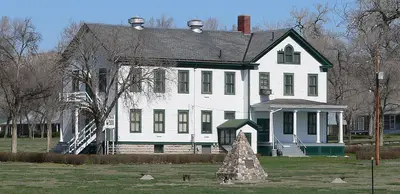
Fort Robinson is a former US Army post in north-west Nebraska, near the town of Crawford. Founded in 1874 to keep watch over the Red Cloud Agency, it saw some of the most painful events of the Plains wars, including the death of the Lakota war leader Crazy Horse in 1877 and the Northern Cheyenne breakout of 1879. It later became a home of the Buffalo Soldiers, the Army's largest remount depot for horses and mules, and a Second World War training centre. Today it is the centrepiece of Fort Robinson State Park and a National Historic Landmark.
Founding
Under the Treaty of Fort Laramie of 1868 the US government promised food and supplies to the Lakota and their allies, which were handed out at agencies. In 1873 the Red Cloud Agency, named after the Oglala leader Red Cloud, moved to the White River in north-west Nebraska. Tension there was high. In February 1874 the acting agent, Frank Appleton, was shot dead at the agency, and Lieutenant Levi Robinson was killed in an ambush while escorting a wood train. Troops were sent from Fort Laramie in March 1874, and their camp near the agency was named Camp Robinson after the dead lieutenant. It became Fort Robinson in December 1878.
Crazy Horse
After the Battle of the Little Bighorn the Army kept up its pressure through the winter, and the Lakota bands began to come in. On 6 May 1877 Crazy Horse surrendered at Camp Robinson with some 889 of his people, laying down their arms in a long procession. Over the summer rumours spread that he meant to break out or to make trouble, and army officers and some Lakota leaders came to distrust him. On 5 September 1877 he was brought to the post and, when he realised he was being taken into the guardhouse, he drew a knife and struggled as soldiers and Indian police tried to hold him. In the scuffle he was fatally wounded by a bayonet, and he died that night. Most accounts say one of the guards struck the blow, but not all agree on who it was. Accounts differ on exactly what happened, on whether the thrust was deliberate, and on how far the arrest had been planned.
The Cheyenne breakout
In 1877 the Northern Cheyenne were moved south to a reservation in Indian Territory. Many fell sick there and were short of food, and in September 1878 more than 300 of them, led by Dull Knife (also called Morning Star) and Little Wolf, broke away and headed for their old country in the north. In north-west Kansas, warriors of the band killed settlers, among them eighteen or nineteen people along Sappa and Beaver CreeksNeeds further sources in Decatur County at the end of September (accounts differ on the number). The group later split. Dull Knife's people made for the Red Cloud Agency, not knowing that it had been moved, and in October 1878 troops brought 149 men, women and children into Fort Robinson.
At first the Cheyenne were allowed to move about the post. Dull Knife asked to be allowed to join Red Cloud or to stay in the north, but the government insisted that they go back south, and the Cheyenne refused. By late December they were confined to their barracks, and early in January 1879 the post commander, Captain Henry W. Wessells, cut off their food and fuel to force them to give in. On the night of 9 January they broke out, shooting the guards with weapons they had hidden, and fled into the snow along the White River. Soldiers pursued them for nearly two weeks until the last group was trapped near Antelope Creek on 22 January. In all, 64 Cheyenne and 11 soldiers were killedNeeds further sources, and the episode is sometimes called the Fort Robinson massacre. Dull Knife and some of his family escaped and reached Red Cloud's people. The Army held a board of inquiry, and a Senate committee investigated the Cheyennes' removal; in 1884 the Northern Cheyenne were given a reservation in Montana.
Buffalo Soldiers and the remount years
The railway reached the fort in 1886, and from 1887 it became the headquarters of the 9th Cavalry, one of the Army's regiments of Black soldiers (see Buffalo Soldier). In 1890 the 9th rode from Fort Robinson to Pine Ridge during the Ghost Dance troubles. The 10th Cavalry followed in the early 1900s.
In 1919 the fort became a Quartermaster Remount Depot, which grew into the world's largest centre for breeding and training army horses and mules. American Olympic riders trained there in the 1930s. During the Second World War it was a training centre for war dogs and held a camp for German prisoners of war. The Army left in 1948, the state park was created in the 1950s, and the fort and the Red Cloud Agency site became a National Historic Landmark in 1960.
Legend and history
- Crazy Horse's last words. Several dying speeches are attributed to him, mostly recorded long afterwards. How much of them he said is Unknown.
- No photograph. No authenticated photograph of Crazy Horse exists, and the pictures sometimes printed as his are disputed.
In Westerns
John Ford's Cheyenne Autumn (1964) tells the story of the Northern Cheyenne exodus, with a long sequence at Fort Robinson, though it changes many details. The death of Crazy Horse at the fort is the climax of Chief Crazy Horse (1955).
Key facts
- Location: near Crawford, Dawes County, Nebraska
- Founded: March 1874, as Camp Robinson; renamed Fort Robinson December 1878
- Named after: Lieutenant Levi H. Robinson, killed in February 1874
- Death of Crazy Horse: 5 September 1877
- Cheyenne breakout: 9–22 January 1879
- Status: Fort Robinson State Park; National Historic Landmark (1960)
- Country: United States (Wikidata P17)
- Located in: Dawes County, Sioux County (Wikidata P131)
- Instance of: fort (Wikidata P31)
- State park: 1956 (Wikipedia infobox)
See also
Nearby
- Fort Laramie National Historic Site 103 km
- Deadwood, South Dakota 191 km
- Cheyenne, Wyoming 202 km
- Johnson County War 295 km
Gallery 1

Sources
- Fort Robinson - Wikipedia en.wikipedia.org
- Wikidata: Q5471939 wikidata.org
- Cyrus Townsend Brady, Indian Fights and Fighters: The Soldier and the Sioux (New York: McClure, Phillips, 1904), ch. 10 §IV – Project Gutenberg gutenberg.org
- Jim Kornberg, “The Death of Chief Crazy Horse” (27 Jun 2009) – True West Magazine truewestmagazine.com
- Roger T. Grange Jr., “Fort Robinson: Outpost on the Plains”, Nebraska History 39:3 (Sep 1958) – Project Gutenberg reprint gutenberg.org
- Nebraska State Historical Society, "Fort Robinson Timeline" (read via WebFetch; 403 to curl) history.nebraska.gov
- NPS, National Historic Landmark nomination, Fort Robinson and Red Cloud Agency (1976, updated 1983) npgallery.nps.gov
- Nebraska History (1958), Fort Robinson article history.nebraska.gov
- NPS Little Bighorn, "Crazy Horse" nps.gov
- Wikimedia Commons: RedCloudAgency.jpg commons.wikimedia.org
- Wikimedia Commons: Fort Robinson post HQ 2.jpg commons.wikimedia.org
