
Texas Ranger Division
Some statements on this page are still being checked and are marked "Needs further sources".
The Texas Rangers are the oldest state law-enforcement body in the United States and one of the most famous in the world. For nearly two centuries they have guarded the Texas frontier, hunted outlaws and rustlers and kept the peace, and the lone Ranger riding out against long odds became a lasting figure of Western legend.
Origins
Settlers in Mexican Texas in the 1820s raised small companies of mounted men to "range" the country and protect their homes. Stephen F. Austin is usually credited with calling up the first such company in 1823. During the Texas Revolution of 1835, the provisional government formally created a corps of Rangers. Accounts differ on which date marks the true founding, and the modern division generally celebrates 1823.
Frontier fighters
Under the Republic of Texas and after statehood in 1845, Ranger companies defended settlements on the frontier and fought in the Mexican–American War. Captain John Coffee "Jack" Hays and his men were among the first to carry Colt revolvers, and Captain Samuel Walker worked with Samuel Colt on the powerful Colt Walker revolver of 1847, the ancestor of later Colts such as the Single Action Army.
Lawmen
In 1874 the Texas legislature created the Frontier Battalion and the Special Force, turning the Rangers into full-time lawmen. They broke up bands of rustlers and robbers and tracked down killers such as John Wesley Hardin, who was arrested by Ranger John B. Armstrong in 1877. They also ended the career of the outlaw Sam Bass, who was fatally wounded in a fight with Rangers at Round Rock in 1878. A saying grew up around their reputation: "one riot, one Ranger".
A mixed record
The Rangers' long history includes great courage and also hard episodes. During the Mexican Revolution, raiders from across the Rio Grande attacked ranches, railways and settlements in South Texas in 1915–16Needs further sources, killing American civilians and soldiers. In the violence that followed, some Rangers and local posses killed Mexican and Mexican-American residents without trial. The best-documented case came at Porvenir in January 1918, when Rangers of Company B, with local ranchers and soldiers, took fifteen unarmed men and boys from the village and shot them. The state's adjutant general condemned the killings and the company was disbanded, and a legislative investigation in 1919 led to reforms that cut the size of the force. The force was reformed several times, and in 1935 it became part of the new Texas Department of Public Safety.
Today and in legend
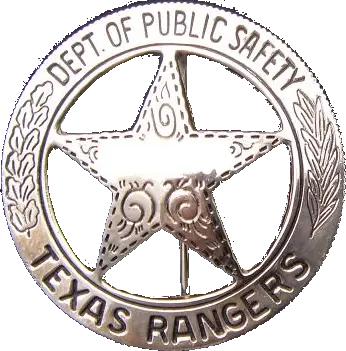
Today the Texas Ranger Division is part of the Texas Department of Public Safety, handling major crimes, corruption and searches for fugitives. Its silver star on a wheel, cut from a Mexican coin, remains one of the most famous badges in America. The Rangers have appeared in countless stories and films, from The Texas Rangers (1936) to the radio and television hero the Lone Ranger. In 1901 Arizona Territory modelled its own short-lived Arizona Rangers on the Texas force.
Key facts
- Founded: accounts differ (1823 or 1835) (TSHA, 'Texas Rangers'; Texas DPS)
- Country: United States (Wikidata P17)
- Instance of: law enforcement agency, state agency of Texas (Wikidata P31)
- Today: a division of the Texas Department of Public Safety that handles major investigations (Texas DPS)
Gallery 1

Sources
- Texas Ranger Division - Wikipedia en.wikipedia.org
- Wikidata: Q510865 wikidata.org
- Proceedings of the Joint Committee of the Senate and the House in the Investigation of the Texas State Ranger Force (Austin, 1919), vol. I (vol. III at scholarworks.utrgv.edu/lrgv/35) – UTRGV ScholarWorks scholarworks.utrgv.edu
- Robert Keil, Bosque Bonito: Violent Times along the Borderland during the Mexican Revolution (Alpine: Center for Big Bend Studies, Sul Ross State University, 2002) cbbs.sulross.edu
- Porvenir Massacre – Handbook of Texas Online (Texas State Historical Association); quotes Adj. Gen. James A. Harley to Capt. J. M. Fox, 12 June 1918 tshaonline.org
- Plan of San Diego – Handbook of Texas Online (Texas State Historical Association) tshaonline.org
- Canales, José Tomás [J. T.] – Handbook of Texas Online (Texas State Historical Association) tshaonline.org
- Porvenir Massacre, Texas Historical Commission marker 18324 (approved 2015) – Texas Historic Sites Atlas atlas.thc.texas.gov
- TSHA Handbook of Texas, "Texas Rangers" tshaonline.org
- Texas Department of Public Safety, "History of the Texas Rangers" dps.texas.gov
- TSHA Handbook of Texas, "Cattle Rustling" tshaonline.org
- Wikimedia Commons: Txrangers.jpg commons.wikimedia.org
- Wikimedia Commons: Badge of the Texas Ranger Division.png commons.wikimedia.org
