
Vaquero
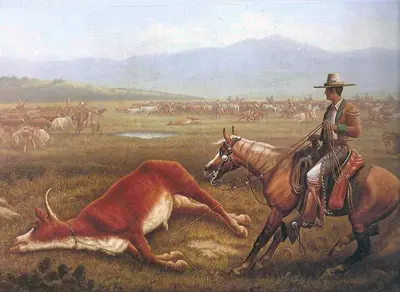
A vaquero is a mounted cattle herder in a tradition that began in Spain and grew up in Mexico. Long before there were American cowboys, vaqueros were working huge herds on open land from horseback. Their skills, their gear and many of their words were taken up by the cowboys of Texas, California and the Great Basin, so the vaquero is in many ways the father of the cowboy.
The name
Vaquero is Spanish for a cowherd, from vaca, "cow". The English word buckaroo, still used by cowboys in Nevada, Oregon and Idaho who keep to the old style, most likely comes from vaquero; it was first recorded in American English in 1827.
From Spain to New Spain
Cattle ranching on horseback had grown up on the dry grazing lands of the Iberian Peninsula, where herds needed so much ground that a worker on foot could not cover it. In the 16th century Spanish settlers brought cattle and horses to Mexico, then called New Spain. Both multiplied fast on the open land, and great ranches, or haciendas, grew up. Many early vaqueros were of mixed Spanish, African and Indigenous descent, working for landowners of Spanish descent. The tradition later spread north into what are now Texas, New Mexico, Arizona and California, and related traditions grew up in South America, such as the gauchos of Argentina.
The vaquero's skills and gear
Vaqueros developed most of the tools and methods that Western cattle work still depends on:
- Roping. The vaquero's braided rawhide rope, la reata, gave English the word "lariat", and lazo became "lasso".
- The saddle. Vaqueros used a deep, heavy saddle with a strong horn to tie or wrap the rope around after catching a cow, the ancestor of the Western saddle.
- Leather leg protection. Chaparreras, worn against thorny brush, became cowboy "chaps".
- Horse training. The jáquima gave the "hackamore", and the vaquero way of training a horse slowly in a bosal before moving it to a spade bit is still followed by many horsemen.
- The roundup. Rodeo, a gathering of cattle, gave its name to the sport, and rancho gave English "ranch".
Vaqueros and cowboys
In Texas, Anglo settlers learned cattle work from Tejano vaqueros, and that style spread north along the cattle trails with the Texas Longhorn. In California, the Californio vaqueros of the Spanish and Mexican ranchos developed a slower, more ornate style of horsemanship, which passed to the buckaroos of the Great Basin. Many vaqueros also rode on the great cattle drives. The tradition is still alive in northern Mexico and the American South-West, and Mexican charrería keeps the vaquero's skills as a competitive sport.
See also
Key facts
- Country: Brazil (Wikidata P17)
- Instance of: profession (Wikidata P31)
Gallery 2



Sources
- Vaquero - Wikipedia en.wikipedia.org
- Wikidata: Q1401609 wikidata.org
- Philip Ashton Rollins, The Cowboy: His Characteristics, His Equipment (1922) archive.org
- Emerson Hough, The Story of the Cowboy (1897) archive.org
- TSHA Handbook of Texas, "Vaquero" tshaonline.org
- American Heritage Dictionary, "buckaroo" ahdictionary.com
- Wikimedia Commons: Vaqueiro Gonterre 1.JPG commons.wikimedia.org
- Wikimedia Commons: Music of the Plains (mural study, Kilgore, Texas Post Office) SAAM-1974.28.333 1.jpg commons.wikimedia.org
- Wikimedia Commons: Vaqueros.jpg commons.wikimedia.org
