
Smith & Wesson Model 3
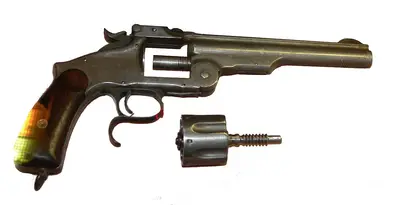
The Smith & Wesson Model 3 is a single-action, top-break cartridge revolver made by Smith & Wesson of Springfield, Massachusetts, from about 1870 to 1915. Breaking open at the top to throw out all its empty cases at once, it could be reloaded far faster than a Colt, and it became one of the great revolvers of the frontier. Its best-known versions are the "Russian", built in huge numbers for the Tsar's army, and the "Schofield", modified for the US cavalry.
Top-break design
Pressing a latch let the barrel and cylinder tip forward on a hinge. As they swung down, an extractor star pushed all six cases clear, so a rider could empty and reload the cylinder quickly, even on horseback. The US Army adopted the .44 Model 3 "American" in 1870, its first standard-issue cartridge revolver, at a time when most military pistols were still cap-and-ball guns, slow to load and easily spoiled by damp weather.
Russian and Schofield models
In 1871 the Imperial Russian Army ordered some 41,000 Model 3s in .44, and Russian inspectors insisted on a series of improvements that produced the First, Second and Third Model Russians. The .44 Russian cartridge developed for them won a name for accuracy and later fathered the .44 Special. Major George W. Schofield, a US cavalry officer, patented a stronger frame-mounted latch that a cavalryman could work with one hand, and in 1875 the Army ordered "Schofield" revolvers. Smith & Wesson chambered them for its own, shorter .45 Schofield round. That caused supply trouble, because the Schofield could not take the longer .45 Colt cartridge used in the Single Action Army, and in the end the Army kept the Colt as its main revolver. Surplus Schofields were later sold off, and Wells Fargo bought many for its agents, cutting their barrels to five inches.
Frontier users
The Model 3 had many well-known owners, though some attributions rest on later tradition. Jesse James is said to have carried one, and Robert Ford is widely reported to have used a Model 3 to kill him in 1882. John Wesley Hardin, Pat Garrett, Theodore Roosevelt and Virgil Earp are also linked with the gun, and Wyatt Earp is often said to have used one at the Gunfight at the O.K. Corral. In the 1890s Frank Butler gave his wife, Annie Oakley, a gold-plated, engraved New Model No. 3 with pearl grips. Schofields served through the Indian Wars and were still around in the Spanish–American War.
On screen
In Unforgiven (1992) the young would-be gunman calls himself the "Schofield Kid" after his revolver, and Clint Eastwood's William Munny takes up the Kid's Schofield for the final showdown. Smith & Wesson and the Italian maker Uberti both made modern reproductions.
Key facts
- Maker: Smith & Wesson
- Action: single action, top-break with automatic ejection
- Production: about 1870–1915
- Main calibres: .44 S&W American, .44 Russian, .45 Schofield
- Key variants: American, Russian, Schofield, New Model No. 3
- Military users: US Army, Imperial Russia and others
- Instance of: weapon model (Wikidata P31)
See also
Seen in
- Unforgiven (1992)
- Tombstone (1993)
- 1883 (2021)
Gallery 1

Sources
- Smith & Wesson Model 3 - Wikipedia en.wikipedia.org
- Wikidata: Q1504980 wikidata.org
- Wikimedia Commons: S%26W Schofield Model.jpg commons.wikimedia.org
- Wikimedia Commons: Smith-et-Wesson-Model-3-cal-44-1874-1878-p1030157.jpg commons.wikimedia.org
