
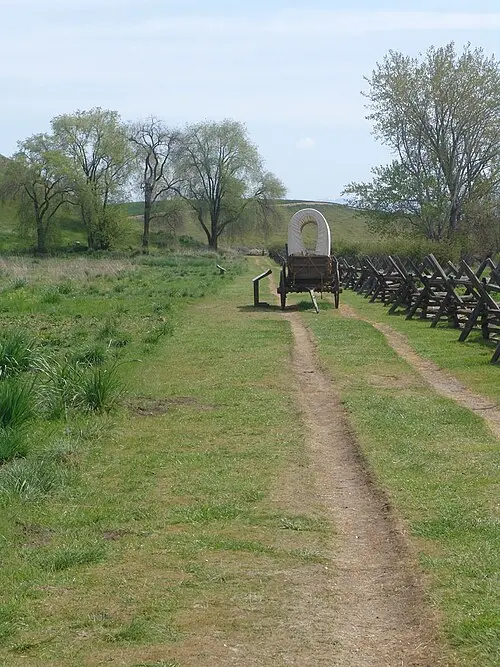

The Whitman Mission at Waiilatpu, the Cayuse "Place of the Rye Grass", was a Protestant mission founded in 1836 by the physician Marcus Whitman and his wife Narcissa beside the Walla Walla River, near present-day Walla Walla, Washington. For eleven years it was a church, school, farm, clinic and, in its last years, a resting place on the Oregon Trail. On 29 November 1847 a small group of Cayuse men attacked it, killing the Whitmans and eleven others and taking about fifty people captive. The killings led to the Cayuse War and to Congress making Oregon a United States territory in 1848. The site is now Whitman Mission National Historic Site.
Founding
In 1835 Marcus Whitman and the Reverend Samuel Parker travelled to the Rocky Mountain fur-trade rendezvous to look for mission sites among the Nez Perce and Cayuse. At the rendezvous Whitman cut a three-inch iron arrowhead out of the back of the mountain man Jim Bridger, which won him respect among both trappers and Indians. The next year he returned with Narcissa, the Reverend Henry and Eliza Spalding and the carpenter William Gray. Travelling with a fur company caravan, Narcissa Whitman and Eliza Spalding became the first white American women known to cross the Rocky Mountains overland. Their journey helped show that families could make the trip to Oregon.
The missionaries were sent by the American Board of Commissioners for Foreign Missions, a Congregational and Presbyterian body based in Boston. Whitman chose a site on Cayuse land about 25 miles east of the Hudson's Bay Company post at Fort Walla Walla, while the Spaldings settled 120 miles away among the Nez Perce at Lapwai, in present-day Idaho. Dr John McLoughlin of the Hudson's Bay Company advised against the interior sites but gave the missionaries supplies and let the women spend the first winter at Fort Vancouver.
Life at Waiilatpu
The Whitmans farmed, preached, held school for Cayuse children and treated the sick. Their daughter, Alice Clarissa, born at Waiilatpu on 14 March 1837, was the first child born to American parents in the Oregon Country. Tiloukaikt, headman of the Cayuse band that wintered nearby, welcomed her as a "Cayuse girl" because she was born on Cayuse land. She drowned in the river behind the mission on 23 June 1839, aged two.
By 1840 about fifty Cayuse families were growing crops on small plots near the mission. But the Cayuse kept their seasonal round of hunting, fishing and root-gathering, and few took up full-time farming. They liked Bible stories and hymns, but rejected Whitman's Calvinist teaching that without conversion they were lost, and in 1845 the American Board admitted that no Cayuse had formally joined its churches. Customs clashed too. Cayuse expected to come and go freely and to receive gifts in return for the use of their land and timber; the Whitmans fenced the fields and kept the Cayuse out of the family rooms, and Whitman refused to pay for the land, believing it had been given to the mission. Rivalry with the Catholic priests who arrived in the region in 1838 added to the strain.
After 1843, when Whitman travelled back with the first great wagon train on the Oregon Trail, Waiilatpu became a stopping place for emigrants. The Whitmans gave food, shelter and medical care to hundreds of travellers and took eleven orphans into their home, among them the seven Sager children, whose parents had died on the trail in 1844. Whitman's own letters show that he came to believe his greatest work would be to help white settlement of the country. About 1,500 emigrants crossed Cayuse land in 1844 and twice as many the next year, and many Cayuse feared they would lose their land.
The killings of November 1847
In the autumn of 1847 measles reached the Cayuse, who had no resistance to it. The source is uncertain: it may have come with that year's wagon trains or with a Cayuse and Walla Walla trading party returning from California. Within about two months a large share of the Cayuse living near the mission died, many of them children, while the white patients at the mission mostly recovered. Among the Cayuse, a healer whose patients died could be suspected of sorcery and killed. Whitman knew of the custom and had been threatened under it before. A newcomer at the mission, Joe Lewis, told the Cayuse that Whitman was poisoning them so that white people could take their land.
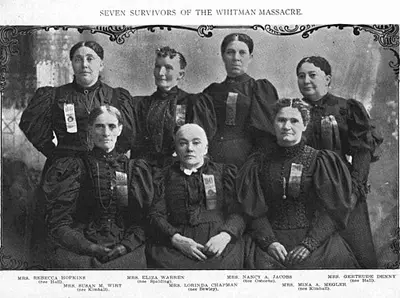
On the afternoon of 29 November 1847, a small group of Cayuse men came to the mission house, hid their weapons under blankets and asked for medicine. When Whitman turned to fetch it he was struck from behind with a tomahawk. By nightfall Marcus and Narcissa Whitman and seven other men and boys had been killed, among them John and Francis Sager. Narcissa was the only woman killed. Four more men were killed in the following days, and a man who escaped is believed to have drowned trying to reach Fort Vancouver. About fifty survivors, mostly women and children, were held captive. Two of the children, Louise Sager and Helen Mar Meek, died of measles during the captivity. Accounts differ on the exact numbers and on how many Cayuse took part, but most accounts describe a small group acting against the wishes of many in the tribe.
Mercy and rescue
Not everyone at Waiilatpu took sides by race or creed. Accounts say at least one Cayuse headman tried in vain to stop the killing, and a few residents were allowed to leave unharmed. The Catholic priest Jean-Baptiste Brouillet reached the mission soon after the attack, buried the dead and spoke with the captives. Riding away, he met Henry Spalding on the trail, warned him that the attackers might be looking for him and gave him what food he had so that he could escape. Spalding made his way back to his family at Lapwai, and wrote to the Catholic bishop asking for help and urging restraint rather than revenge. Ten-year-old Eliza Spalding, who spoke the Cayuse language, served as interpreter for her fellow captives.
On 29 December 1847 Peter Skene Ogden of the Hudson's Bay Company ransomed the captives for blankets, shirts, guns, ammunition and tobacco. The company never asked the Americans to repay the cost.
Aftermath
The provisional government of Oregon raised volunteers, and the Cayuse War followed. The killings also hastened the bill that made Oregon a territory of the United States on 14 August 1848. In 1850 five Cayuse men, among them Tiloukaikt and Tomahas, gave themselves up and were tried for murder at Oregon City. They argued that Cayuse law allowed the killing of a healer whose medicine killed his patients. They were found guilty and hanged on 3 June 1850. Accounts differ on whether all five had taken part in the killings. The Cayuse later settled on the Umatilla Reservation in Oregon, and today they are one of the Confederated Tribes of the Umatilla Indian Reservation.
Legend and history
- "Whitman saved Oregon." For half a century after the killings, Henry Spalding and others told how Whitman made his winter ride east in 1842–43 to warn the President of a British and Catholic plot to take Oregon, and so saved the Northwest for the United States. The record shows that he went east to persuade the American Board not to close the mission. The story was shown to be a legend in 1901.
- A Catholic plot? Spalding and some other Protestants later accused Catholic priests of stirring up the Cayuse. No good evidence supports the charge, and Father Brouillet, who buried the dead and helped Spalding escape, answered it in print.
- Martyrs or meddlers? The Whitmans have been honoured as Christian martyrs and pioneers, with a statue of Marcus in the US Capitol, and they have also been criticised for failing to understand the Cayuse. Accounts differ on how much the measles deaths, the fear of losing land and the missionaries' own conduct each weighed in the attack. All three played a part.
Key facts
- Founded: 1836, by Marcus and Narcissa Whitman
- Place: Waiilatpu, on the Walla Walla River, about six miles west of Walla Walla, Washington
- Sponsor: American Board of Commissioners for Foreign Missions
- Killings: 29 November 1847 and the days following; 13 killed, a 14th presumed drowned
- Captives: about 50, ransomed on 29 December 1847 by Peter Skene Ogden of the Hudson's Bay Company
- Today: Whitman Mission National Historic Site (established 1936)
- Founded in 1836 by Marcus and Narcissa Whitman for the American Board of Commissioners for Foreign Missions at Waiilatpu, on Cayuse land (NPS; Oregon Encyclopedia; HistoryLink).
- The Whitmans farmed, preached, ran a school and treated the sick; after 1843 the mission was a stopping place for Oregon Trail emigrants (NPS Handbook 37; HistoryLink).
- In autumn 1847 measles spread to the Cayuse, and about half the tribe died within two months, while most white patients recovered (NPS Handbook 37; Oregon Encyclopedia).
- A newcomer, Joe Lewis, told the Cayuse that Whitman was poisoning them; under Cayuse custom a healer whose patients died could be killed (NPS Handbook 37; HistoryLink).
- On 29 November 1847 a group of Cayuse men killed the Whitmans and eleven others and took about fifty captives; most accounts say only a few extremists planned the attack (NPS Handbook 37; Oregon Encyclopedia; HistoryLink; Brouillet, 1853).
- Father J.-B. A. Brouillet buried the dead, and Peter Skene Ogden of the Hudson's Bay Company ransomed the captives in December 1847 (Brouillet, 1853; HistoryLink; NPS).
- The killings led to the Cayuse War and hastened the act of 14 August 1848 creating Oregon Territory; five Cayuse men were tried and hanged at Oregon City in 1850 (Oregon Encyclopedia; HistoryLink).
- Legend vs history: the 'Whitman saved Oregon' story and the charge that Catholic priests stirred up the Cayuse are not supported by the record (Bourne, 1901; Brouillet, 1853; HistoryLink).
See also
Gallery 1

Sources
- Whitman Mission National Historic Site – National Park Service nps.gov
- National Park Service Historical Handbook No. 37, Whitman Mission (1959) npshistory.com
- J. B. A. Brouillet, Authentic Account of the Murder of Dr. Whitman and Other Missionaries (1853 ed.) archive.org
- HistoryLink.org essay 5192 (Jason Lee) historylink.org
- Whitman Murders – Oregon Encyclopedia (Oregon Historical Society) oregonencyclopedia.org
- Edward G. Bourne, Essays in Historical Criticism (1901) – 'The Legend of Marcus Whitman' archive.org
- Whitman Mission National Historic Site - Wikipedia en.wikipedia.org
- Wikidata: Q3499361 wikidata.org
- Wikimedia Commons: Oregon Trail Whitman Mission WA NPS.jpg commons.wikimedia.org
- Wikimedia Commons: Seven Survivors of Whitman Massacre.jpg commons.wikimedia.org