

✦ Legend
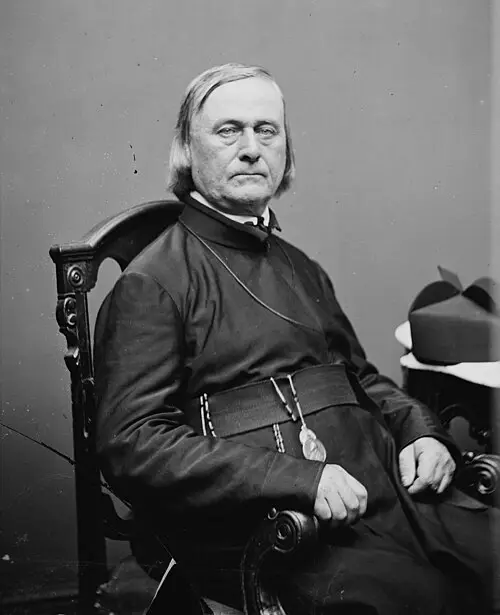
Pierre-Jean De Smet (1801–1873) was a Belgian-born Jesuit priest who became the best-known Catholic missionary of the American West. Known to many tribes as the "Black Robe", he founded missions among the Salish (Flathead), Coeur d'Alene and other peoples of the northern Rockies, travelled some 180,000 miles by his own reckoning, and was trusted as a peacemaker by Native leaders and the United States government alike. In 1868 he rode into Sitting Bull's camp to persuade the Lakota to talk peace, a mission few other white men would have dared.
Early life
De Smet was born on 30 January 1801 in Dendermonde (Termonde), in what is now Belgium. Hoping to become a missionary to the Indians, he sailed for America in 1821 with a group of young Belgians and entered the Jesuit novitiate at White Marsh, Maryland. In 1823 he was one of the small party of Jesuits sent west to found a new mission at Florissant, near St Louis, Missouri. The party brought with it six enslaved Black people from the Jesuits' Maryland farm, who were made to build and work the new seminary farm. De Smet was ordained a priest in 1827 and became a US citizen in 1833.
The Black Robe in the Rockies
His first mission, in 1838–39, was St Joseph's among the Potawatomi at Council Bluffs, Iowa, where he was appalled by the harm the whiskey trade was doing. In those years the Salish of the Bitterroot Valley, who had learned something of Christianity from Iroquois fur trappers living among them, sent four delegations on the long journey to St Louis to ask for a "black robe". De Smet met the last of them in 1839 and asked to go.
In 1840 he travelled west with an American Fur Company caravan. On 5 July he said the first Mass in what is now Wyoming, near the Green River, and at Pierre's Hole he was welcomed by some 1,600 Salish and Pend d'Oreille people. The next year he returned with Fathers Gregorio Mengarini and Nicolas Point and three lay brothers, and founded St Mary's Mission in the Bitterroot Valley, near present-day Stevensville, Montana. He also helped found the Sacred Heart Mission among the Coeur d'Alene, whose later church at Cataldo, Idaho, is the oldest building in that state. He crossed the Atlantic many times to raise money and recruit priests and nuns, and in 1844 he brought more Jesuits and a group of Sisters of Notre Dame de Namur round Cape Horn to the Columbia River. In 1845–46 he made a long winter journey through the Canadian Rockies to meet the Cree, Chippewa and Blackfoot peoples, wintering at Fort Edmonton.
His letters and books, among them Letters and Sketches (1843) and Oregon Missions and Travels over the Rocky Mountains (1847), made him famous on both sides of the ocean and gave many readers their first picture of the northern West.
Peacemaker
After 1846 his superiors kept him in St Louis, but the government turned to him again and again. In 1851 he attended the great council at Horse Creek near Fort Laramie, where some ten thousand Sioux, Cheyenne, Arapaho, Crow and other Plains people met US commissioners (see Fort Laramie). In 1858 he went west as an army chaplain after fighting in the Pacific Northwest, and helped restore peace with the Yakama, Palouse, Spokane, Coeur d'Alene and other peoples there. During the Dakota troubles of the 1860s he refused to lend his name to a punitive expedition, saying that he would go only as a man of peace.
In 1868, aged 67, he travelled up the Missouri with the peace commissioners. Against advice, he crossed the Badlands with a small party of Lakota guides and interpreters to the great camp on the Powder River, where Sitting Bull and thousands of Lakota received him on 19 June. Sitting Bull would not sign a treaty, but he agreed to send representatives, and Gall and other leaders signed at Fort Rice on 2 July 1868, as part of the Treaty of Fort Laramie. De Smet died in St Louis on 23 May 1873.
Legend and history
- "Friend of the Indians". In his own day he was widely regarded as the white man the western tribes trusted most, and he went unarmed into camps that soldiers could not safely approach. Many of the peace settlements he worked for were later broken, a fact that grieved him.
- Did he stir up the Cayuse? After the 1847 killings at the Whitman Mission, some Protestant ministers accused Catholic priests, De Smet among them, of turning the Cayuse against the Whitmans. No good evidence supports the charge.
- The miles. The figure of 180,000 miles comes from De Smet's own records and is often repeated. Accounts differ on how it was counted, but no one doubts that he was one of the most travelled men of the 19th-century West.
Key facts
- Born: 30 January 1801, Dendermonde, Southern Netherlands (now Belgium)
- Died: 23 May 1873, St Louis, Missouri, US
- Buried: Calvary Cemetery, St Louis (moved from Florissant in 2003)
- Order: Society of Jesus (Jesuits); ordained 1827
- Missions: St Joseph's (Council Bluffs, 1838), St Mary's (Bitterroot Valley, 1841), Sacred Heart (Coeur d'Alene), St Ignatius (Montana, 1854)
- Known for: missions in the northern Rockies; peace councils of 1851 and 1868; his meeting with Sitting Bull (1868)
- Born 30 January 1801 in Dendermonde (Termonde); sailed for America in 1821 and entered the Jesuit novitiate at White Marsh, Maryland (Chittenden & Richardson, 1905; Wikipedia).
- In 1823 he was one of the Jesuit party that went west to found the novitiate at Florissant, Missouri; the party took with it six enslaved people from the Jesuits' White Marsh plantation: Thomas and Molly Brown, Moses and Nancy Queen, and Isaac and Susan Hawkins (1823 articles of agreement, Jesuit Archives; Schmidt, Jesuit Sources, 2019; PBS NewsHour, 2021).
- He was ordained in 1827 (Chittenden & Richardson, 1905).
- In 1840 he travelled west with an American Fur Company caravan to the Salish (Flathead), and in 1841 founded St Mary's Mission in the Bitterroot Valley, Montana (Chittenden & Richardson, 1905; De Smet, 1847).
- His books, including Oregon Missions and Travels over the Rocky Mountains (1847), gave many readers their first picture of the northern West (De Smet, 1847).
- He attended the 1851 Horse Creek (Fort Laramie) council, and in June 1868 crossed to the Lakota camp on the Powder River, where Sitting Bull agreed to send delegates to the peace talks at Fort Rice (Chittenden & Richardson, 1905; Wikipedia).
- He died in St Louis on 23 May 1873 (Chittenden & Richardson, 1905).
See also
Sources
- H. M. Chittenden and A. T. Richardson (eds), Life, Letters and Travels of Father Pierre-Jean De Smet, S.J., vol. 1 (New York, 1905) archive.org
- Pierre-Jean De Smet, Oregon Missions and Travels over the Rocky Mountains in 1845–46 (New York, 1847) archive.org
- Jesuit Archives & Research Center, Saint Stanislaus Seminary (Florissant) records – finding aid jesuitarchives.org
- Kelly L. Schmidt, 'Enslaved Faith Communities in the Jesuits' Missouri Mission', Jesuit Sources (Boston College, 2019) jesuitsourcesdigital.bc.edu
- Gabrielle Hays, 'At least 70 people were enslaved by the Jesuits in St. Louis. Descendants are now telling their stories', PBS NewsHour, 8 Dec 2021 (updated 31 Mar 2022) pbs.org
- Pierre-Jean De Smet - Wikipedia en.wikipedia.org
- Treaty of Fort Laramie with Sioux, etc., 1851 (Kappler text) – Oklahoma State University, Tribal Treaties Database treaties.okstate.edu
- “William Selby Harney” – Oregon Encyclopedia oregonencyclopedia.org
- Wikidata: Q981962 wikidata.org
- Wikimedia Commons: Pierre-Jean De Smet - Brady-Handy.jpg commons.wikimedia.org