

✦ Legend
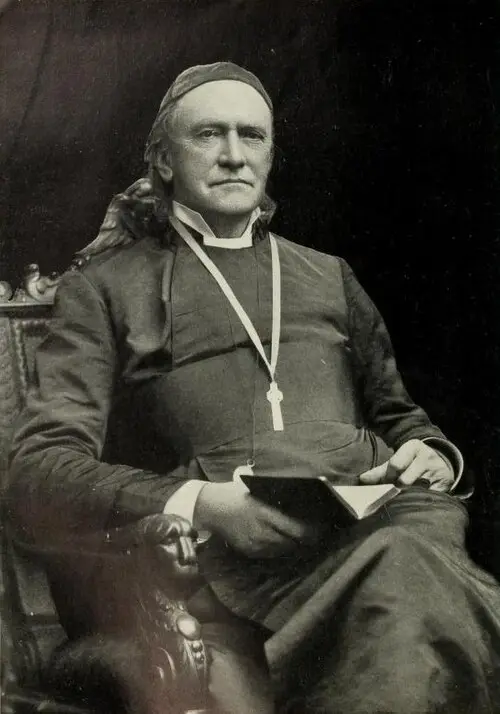
Henry Benjamin Whipple (1822–1901) was the first Episcopal bishop of Minnesota and one of the best-known Christian advocates for Native Americans in the 19th century. For more than forty years he rode across a frontier diocese of some 80,000 square miles, founding churches, schools and missions among settlers, Dakota and Ojibwe. In 1862 he pleaded with President Abraham Lincoln for mercy for Dakota men condemned after the Dakota War, and he spent the rest of his life calling for honest dealing with the tribes. The Dakota called him "Straight Tongue" for his honesty.
Early life and ministry
Whipple was born on 15 February 1822 in Adams, New York. Raised a Presbyterian, he became an Episcopalian through his grandparents and his wife, Cornelia Wright, whom he married in 1842. Poor health cut short his studies at Oberlin, and he worked in his father's business before studying theology. He was ordained deacon in 1849 and priest in 1850, and served as rector of Zion Church in Rome, New York, where he became known for his work among the poor. In 1857 he founded the Church of the Holy Communion in Chicago, the city's first "free" church, where no one paid for a pew. His congregation was drawn from clerks, labourers and railway men, and he preached regularly in the city's prison.
Bishop of the frontier
On 30 June 1859 the Episcopal convention of Minnesota elected Whipple its first bishop, and he was consecrated that October. His diocese covered nearly the whole state, with few roads and scattered settlements. In the spring of 1860 he made Faribault his home and the seat of his diocese. There he built the Cathedral of Our Merciful Saviour and founded schools that grew into Seabury Divinity School, Shattuck School and St Mary's Hall. Under his leadership the diocese grew to some 160 congregations.
From his first tour he included Dakota and Ojibwe communities in his visits. At the Ojibwe mission at Gull Lake he met the Ojibwe deacon John Johnson Enmegahbowh, who became his lifelong friend and co-worker, and in 1876 Whipple ordained the first Ojibwe deacons in Minnesota. He came to believe that the government's system of dealing with the Dakota and Ojibwe badly needed reform, as treaty payments and goods were often delayed or withheld and treaties were not enforced. In letters to Presidents Buchanan and Lincoln he called for that reform, describing the Indian system as "a stupendous piece of wickedness".
The Dakota War of 1862
In August 1862, after treaty payments were delayed and many Dakota were hungry, a faction of Dakota warriors attacked the agencies and farms of the Minnesota River valley. Several hundred settlers, many of them women and children, were killed in six weeks of fighting, though most Dakota did not join the war and some saved settlers' lives. Whipple went at once to St Peter, where he and Cornelia set up a hospital in the town hall and organised the women of the town as nurses. He tended the wounded and buried the dead.
A military commission then tried hundreds of Dakota men in a few weeks and sentenced 303 to death. Whipple, who had met Lincoln at the White House that September, wrote to the President, to senators and to the newspapers. He protested the haste of the trials and the lack of any proper defence, argued that the deeper cause of the war lay in years of broken treaty promises, and denied that the government had the right to order a mass execution. His stand was unpopular in Minnesota, and he was bitterly criticised for it. Lincoln reviewed the trial records himself. In the end 38 men were hanged at Mankato on 26 December 1862, and the other death sentences were not carried out. Lincoln later said that Whipple had moved him "down to my boots". Whipple went on to minister to the Dakota held in the camp at Fort Snelling.
Later life
Whipple served on the Sioux Commission of 1876, the Northwest Indian Commission of 1887 and the Board of Indian Commissioners from 1895. He was a high churchman in doctrine but warm towards other Christians, and he worked closely with Swedish Lutherans. He wintered in Florida in his later years, where he built the Church of the Good Shepherd at Maitland. Cornelia died in 1890, and in 1896 he married Evangeline Marrs Simpson. He died at Faribault on 16 September 1901 and is buried beneath the altar of his cathedral.
Legend and history
- "Straight Tongue". The name, given him by Dakota leaders because he did not lie to them, is well attested in his own lifetime.
- Friend or reformer? Whipple believed that Native people should take up farming, schooling and Christianity and give up their old ways, views now often called paternalistic. He was also far more attentive than government agents to Dakota and Ojibwe grievances, and he risked his standing to defend them when few others would.
Key facts
- Born: 15 February 1822, Adams, New York, US
- Died: 16 September 1901, Faribault, Minnesota
- Buried: Cathedral of Our Merciful Saviour, Faribault
- Church: Episcopal; first Bishop of Minnesota (1859–1901)
- Spouses: Cornelia Wright (married 1842, died 1890); Evangeline Marrs Simpson (married 1896)
- Known for: missions among the Dakota and Ojibwe; his plea to Lincoln for the condemned Dakota (1862); calls for reform of Indian affairs
- Born 15 February 1822 in Adams, New York; consecrated first Episcopal bishop of Minnesota in 1859 and served until his death on 16 September 1901 (MNopedia; Wikipedia).
- He founded churches, schools and missions among settlers and among the Dakota and Ojibwe, and was known among the Dakota as 'Straight Tongue' (MNopedia; Whipple, 1899).
- He campaigned for reform of the federal government's dealings with Native Americans (MNopedia; Whipple, 1899).
- After the Dakota War of 1862 he went to Washington and asked President Lincoln for mercy for the condemned Dakota men; Lincoln reduced the 303 death sentences to 38 (MNopedia; Whipple, 1899; Wikipedia).
- His memoir Lights and Shadows of a Long Episcopate was published in 1899 (Whipple, 1899).
See also
Sources
- Whipple, Henry Benjamin (1822–1901) – MNopedia, Minnesota Historical Society mnhs.org
- Henry B. Whipple, Lights and Shadows of a Long Episcopate (New York, 1899) archive.org
- Henry Benjamin Whipple - Wikipedia en.wikipedia.org
- Wikidata: Q5718030 wikidata.org
- Wikimedia Commons: Portrait of Henry Benjamin Whipple.jpg commons.wikimedia.org