
Fort Worth, Texas
Fort Worth is a city on the Trinity River in north Texas that grew from a small Army outpost of 1849 into "Cowtown", the great cattle town of the Chisholm Trail and later one of the leading livestock markets in the United States. Its proud motto is "where the West begins". In the late 19th century it was a stopping place for trail herds and their cowboys, a railway town, and, in its rowdy district of Hell's Half Acre, a haunt of gamblers and outlaws, among them members of Butch Cassidy's Wild Bunch.
The fort
After the Mexican–American War the Army built a line of small posts across central Texas to guard the frontier settlements. In May 1849, on the orders of General William S. Harney, Brevet Major Ripley Arnold rode north from Fort Graham on the Brazos with a detachment of Company F, 2nd Dragoons, guided by the settler Middleton Tate Johnson. On 18 May they took possession of a bluff overlooking the Clear Fork of the Trinity River, and on 6 June 1849 Arnold named the new post after General William Jenkins Worth, a hero of the Mexican War who had recently died of cholera. Fort Worth was really an outpost of Fort Graham, manned by a few dozen soldiers in rough timber buildings, with no stockade, only a rope marking the perimeter. Its men patrolled the country between the Red River and the Brazos. By 1853 the frontier had moved about a hundred miles west, and on 16 September 1853 the last dragoons rode out for Fort Belknap.
Fort Town
Settlers at once moved into the empty buildings on the bluff, calling their village Fort Town to distinguish it from the post. Among the first were Ephraim Daggett, who gave land for public use, and John Peter Smith, often called the father of Fort Worth, who opened the first school in 1854. A mail stage line reached the village in 1856, and the Butterfield Overland Mail two years later. Despite later legend, the written records show that the town was never seriously threatened by raids from the Plains tribes.
Fort Worth won a fiercely contested election against Birdville to become the seat of Tarrant County in 1856, amid charges of illegal voting, and won a second election decisively in 1860. The Civil War and its aftermath left the town struggling, with only a few hundred people.
The 1860 hangings
On 8 July 1860, in an exceptionally hot summer, fires broke out in Dallas, Denton and other North Texas towns. Some local leaders blamed them on enslaved people supposedly stirred up by Northern abolitionists. By late July, vigilance committees had been formed across North Texas, Tarrant County among them, and the ordinary courts stood aside.
Two hangings of white men at Fort Worth that summer are well documented, and both took place without a trial. The first was William H. Crawford, accused of "tampering with slaves". He was hanged in mid-July (sources give 16 or 17 July) from a pecan tree just west of town. The second was the Rev. Anthony Bewley, a minister of the Northern Methodist Episcopal Church with a mission about sixteen miles south of Fort Worth. Suspicion fell on him partly because of a letter that cast him as an accomplice. Its authenticity was disputed, and Methodist writers called it a forgery. Bewley fled north in mid-July, was caught in Missouri in early September and brought back to Fort Worth. Late on the night of 13 September a mob seized him and hanged him from the same tree. His body was left hanging until the next day. His bones were later put on the roof of a town storehouse, where children played with them.
Historians generally find that no organised plot was ever proved. The Handbook of Texas states that "no hard evidence" was produced against "a single alleged Black arsonist or White abolitionist". A 2020 local study concludes that "No slave conspiracy was ever discovered". Northern Methodists in 1860 called Bewley "an innocent man". The fires' cause is still debated; Denton's citizens blamed new "prairie matches" at the time. Across North Texas the victims included enslaved Black people and white men accused of helping them. The total number killed across Texas is disputed. The Handbook of Texas says at least thirty people died and that other reports suggest closer to 100, while one historian suggests possibly hundreds.
Some people at the time stood against what was done. Northern Methodists collected aid for Bewley's widow in Kansas. One Pittsburgh congregation resolved that his death was "the murder of an innocent man". According to one study, white Fort Worth had "mixed feelings about lynch law", and in April 1861 several men swore an affidavit distancing themselves from Crawford's death. Bewley's descendants honour him as a pastor who "laid down his life for what he believed".
Cowtown
Two things saved Fort Worth after the war: the cattle drives and the railway. In 1867 the first long drive of Texas longhorns bound for the Kansas railheads passed through the town, and for the next fifteen years herds came through every season along the Chisholm Trail. Cowboys stocked up on supplies at Fort Worth before crossing the Red River into Indian Territory, and spent their wages there on the way home. The town was incorporated in 1873.
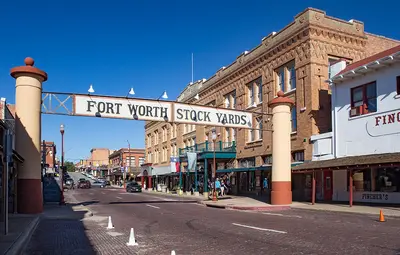
The panic of 1873 halted the building of the Texas and Pacific Railway about 30 miles short of the town, and in 1875 a former Fort Worth lawyer, Robert E. Cowart, wrote in the Dallas Herald that Fort Worth was so sleepy that he had seen a panther asleep in the street by the courthouse. The insult backfired: Fort Worth took up "Panther City" as a proud nickname. The first Texas and Pacific locomotive arrived on 19 July 1876, and the town boomed. By 1880 it had more than 6,600 people, and it went on to become the railway centre of the Southwest. Fort Worth built its own stockyards and began shipping cattle north by rail. The first Fat Stock Show was held in 1896, and the arrival of the Swift and Armour meat-packing companies in 1902 made the stockyards on the city's north side one of the largest livestock markets in the country.
Hell's Half Acre
The cattle trade also brought a district of saloons, dance halls, gambling houses and brothels on the south side of the business district, known as Hell's Half Acre. It grew up in the 1870s to serve the cowhands and drew gamblers, confidence men and outlaws. Many citizens were disgusted by its vice and violence, and in 1876 the town elected Timothy "Longhair Jim" Courtright as city marshal to tame it, but city leaders also knew how much money it brought in, and clean-up campaigns came and went. On 8 February 1887 Courtright, by then a former marshal, was shot dead in a face-to-face gunfight with the gambler Luke Short, a former friend and rival for control of the town's gambling; Short's friend Bat Masterson is said to have spent the night in his cell to protect him from a lynch mob. The Acre lingered into the 20th century, until the preaching and reform work of the ministers J. T. Upchurch and J. Frank Norris, and the arrival of an Army camp in 1917, finally closed it down.
The Fort Worth Five
In November 1900 five members of the Wild Bunch, among them Butch Cassidy, the Sundance Kid, Ben Kilpatrick, Will Carver and Harvey Logan, were in Fort Worth, and they had their portrait taken in their best suits at John Swartz's photographic studio on Main Street. The Pinkerton National Detective Agency obtained a copy and used it on wanted posters across the country. Sundance Square, in the heart of the old downtown, takes its name from the Sundance Kid.
Legend and history
- "Camp Worth"? Accounts differ: it is often said that the post was first called Camp Worth, but its founder always called it Fort Worth in his official letters, and some historians say the Camp Worth name belonged to an Army post at San Antonio.
- When was the photograph taken? The Fort Worth Five portrait was taken on 21 November 1900.
- Where the West begins. The motto has a basis in geography: Fort Worth lies on the edge of the Great Plains, so the eastern part of the city is in the wooded Cross Timbers while the west is flat, open prairie.
Key facts
- Location: Tarrant County, Texas, on the Trinity River
- Established: 6 June 1849, as an Army post (site taken 18 May 1849); abandoned by the Army 16 September 1853
- Named after: General William Jenkins Worth
- Incorporated: 1873
- Railway: Texas and Pacific, 19 July 1876
- Nicknames: Cowtown; Panther City; "where the West begins"
- Landmarks: Fort Worth Stockyards National Historic District; Sundance Square
- Founded/established: 1849 (Wikidata P571)
- Country: United States (Wikidata P17)
- Located in: Tarrant County, Denton County, Parker County (Wikidata P131)
- Instance of: city in the United States, big city, county seat (Wikidata P31)
- Incorporated: 1874 (Wikipedia infobox)
- The Fort Worth Five group portrait of Wild Bunch members was taken at John Swartz's studio in Fort Worth on 21 November 1900 (Pinkerton company history; HistoryNet; fort-worth-five.com)
See also
Nearby
- Fort Griffin 178 km
- Waggoner Ranch 200 km
- Fort Sill 242 km
- 6666 Ranch 295 km
Films shot here
- 1883 (2021)
Gallery 1

Sources
- Fort Worth, Texas - Wikipedia en.wikipedia.org
- Wikidata: Q16558 wikidata.org
- The fort worth five the iconic photo that ended the wild wests most notorious gang - pinkerton.com pinkerton.com
- When the swartz brothers shot texas - historynet.com historynet.com
- fort-worth-five.com fort-worth-five.com
- Wikimedia Commons: Downtown Fort Worth Skyline.jpg commons.wikimedia.org
- Wikimedia Commons: Fort Worth Stock Yards Entrance Wiki (1 of 1).jpg commons.wikimedia.org
