
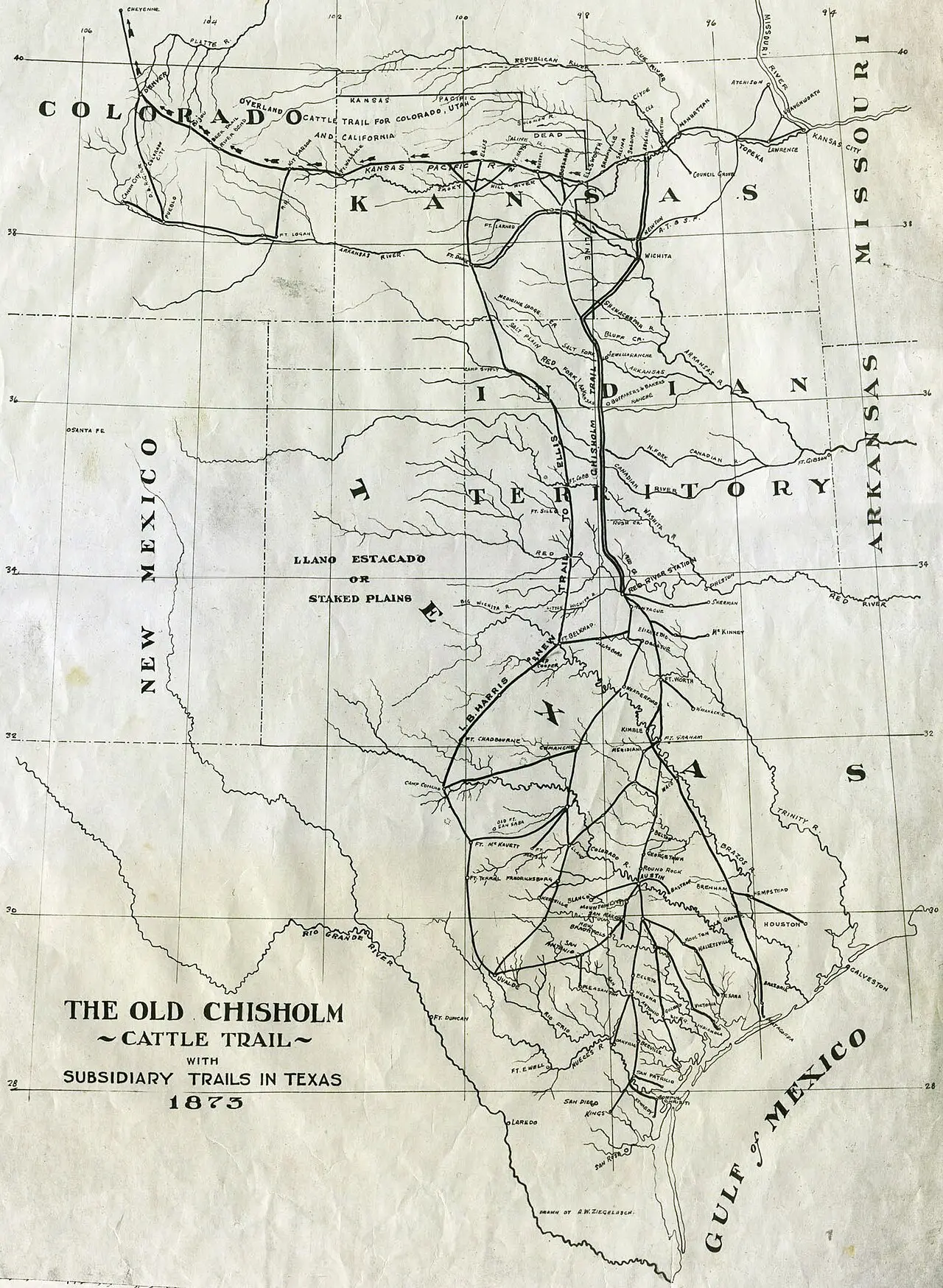

The Chisholm Trail was the most famous cattle trail of the American West. In the years after the Civil War, Texas cowboys drove millions of Longhorn cattle north along it, across the Red River and through Indian Territory (now Oklahoma), to railheads in Kansas. From there the cattle went east by train to the markets and meat-packers. Its main years were 1867 to the mid-1870s. In that short time it created the Kansas cow towns, the cattle drive and the working cowboy who became the hero of a thousand Westerns.
Why the trail began
The Civil War cut Texas off from northern markets, and by 1866 the state was overstocked with half-wild Longhorns. They were worth about $4 a head in Texas, against more than $40 in the North and East. Earlier drives east into Missouri had met armed resistance from farmers, because Longhorns carried ticks that spread "Texas fever" to other cattle. Missouri and Kansas brought in quarantines to keep the herds out.
In 1867 the Kansas Pacific Railway reached Abilene, Kansas, and the cattle dealer Joseph G. McCoy built stockyards and a hotel there. Abilene lay west of the settled farmland, and officials overlooked the fact that it was technically inside the 1867 quarantine area. McCoy invited Texans to bring their herds. Most sources credit O. W. Wheeler with the first herd to come up the trail, about 2,400 head, though McCoy himself named a different herd as the first to arrive in 1867.
Route
The trail was less a single road than a network. TSHA likens it to a tree. Feeder trails from South Texas formed the roots. The trunk ran past San Antonio, Austin, Waco and Fort Worth to the Red River crossing at Red River Station, then north across Indian Territory. The branches led to the various Kansas railheads. Its end point moved as the railways and the quarantine line moved. It was Abilene from 1867 to 1871, followed by Newton, Ellsworth, Wichita and Caldwell.
Life on the drive
A typical outfit of about a dozen men could handle around 2,500 cattle. They included a trail boss, a cook with the chuck wagon, a horse wrangler and the drovers. Each man needed a string of horses, and tough cow ponies such as the Mustang and the Quarter Horse were essential. TSHA gives typical monthly pay as about $90 for a trail boss, $50 or more for a cook and $30 for a drover. A drive could last up to two months. Hazards included crossing the Red and Arkansas rivers and countless creeks, rough country, rustlers and occasional conflicts with Native Americans, whose hunting and crops the herds disrupted.
Numbers
Estimates vary widely and are uncertain. According to TSHA, the US Bureau of Statistics estimated that about 5.2 million cattle were driven north from Texas between 1866 and 1884, more than 2.4 million of them between 1867 and 1875, the Chisholm Trail's main years. Because herds also used other routes, nobody knows how many actually used the Chisholm.
Decline
Farmers kept moving west, and the quarantine line moved with them. In 1876 Kansas pushed it far enough west to cut off Abilene and the older cow towns. Much of the trade then shifted to the Great Western Cattle Trail and Dodge City. In 1885 Kansas closed the state to most Texas cattle.
Name and myth
The trail is named after Jesse Chisholm, a trader of Scottish and Cherokee descent who ran trading posts in Indian Territory and at the site of Wichita, and who died in 1868. The route grew from a path laid out by the Delaware scout Black Beaver in 1861 and a wagon road Chisholm set up around 1864. How far the name properly reaches is disputed. TSHA notes that the name first appeared in print in 1869, and that government surveys of 1871–73 apply "Chisholm's Trail" to only about 80 miles in Indian Territory. Elsewhere the route was mapped as the "Abilene Cattle Trail" or "Eastern Trail". The name was applied to the whole route mainly after 1911, helped by songs, fiction and a highway campaign. Joseph McCoy himself objected that it should be called the Abilene Trail. Other accounts, by contrast, say the whole route was known as the Chisholm Trail by 1869.
Legacy
The trail inspired the cowboy song "The Old Chisholm Trail" and at least 27 films about fictional first drives, most famously Howard Hawks's Red River (1948), starring John Wayne. US Route 81 roughly follows it through Oklahoma, and the Chisholm Trail Heritage Center in Duncan, Oklahoma, tells its story.
Key facts
- Main years: 1867 to about 1875 (drives continued into the 1880s)
- From: South Texas, via San Antonio and Fort Worth
- To: Kansas railheads, first Abilene, later Newton, Ellsworth, Wichita and Caldwell
- Named after: Jesse Chisholm (died 1868)
- Cattle driven north from Texas (1866–84): about 5.2 million (estimate)
- Ended by: Kansas quarantine laws (1876 and 1885)
- Ran from south Texas, across the Red River and Indian Territory (Oklahoma), to Kansas railheads
- Built from a path laid out by Black Beaver in 1861 and a wagon road set up by Jesse Chisholm around 1864
- By 1869 the whole route from Texas to Kansas was known as the Chisholm Trail
- Joseph G. McCoy set up a cattle-shipping depot at Abilene, Kansas, in 1867
- About 1.5 million cattle were driven to Abilene between 1867 and 1871 (Britannica)
- Described after years of use as 200–400 yards wide (Kansas Historical Society)
See also
Sources
- Chisholm Trail - Wikipedia en.wikipedia.org
- Chisholm Trail - Britannica britannica.com
- Cowtowns - Kansapedia, Kansas Historical Society kansashistory.gov
- Wikimedia Commons: 1873 Map of Chisholm Trail with subsidiary trails in Texas.jpg commons.wikimedia.org
- Chisholm Trail - Handbook of Texas Online (Texas State Historical Association) tshaonline.org
- Wikidata: Q477217 wikidata.org