

Frontier towns were the boomtowns of the American West. Mining camps grew up almost overnight around a gold or silver strike, and cow towns grew up where a railway met the cattle trails from Texas. The best known, Tombstone in Arizona, Dodge City and Abilene in Kansas, and Deadwood in Dakota Territory, became bywords for saloons, gambling and gunplay. Their real histories are shorter, smaller and more complicated than the legends. Several now survive mainly as historic districts and tourist attractions.
Tombstone, Arizona
The prospector Ed Schieffelin found silver in the San Pedro Valley of south-eastern Arizona in 1877. The best-known story of the name is that he had been told that all he would find in that country was his own grave marker, and he named his first claim accordingly. Another account says the name came from granite outcrops in the nearby Dragoon Mountains, so the origin is disputed. The town was laid out in 1879 on a mesa above the Goodenough Mine, on land long inhabited by the Hohokam people, and it was incorporated in 1881. It became the most productive silver district in Arizona, yielding an estimated $40 to $85 million in bullion.
By 1880 the town had saloons, gambling halls, dance halls and brothels, but also four churches, three newspapers (including the Epitaph, founded 1880), two banks and an ice-cream parlour. The Bird Cage Theatre opened on Allen Street on 25 December 1881. In 1882 The New York Times called it "the wildest, wickedest night spot between Basin Street and the Barbary Coast".
Politics were tense. Townspeople and mine owners were mostly Northerners, while many local ranchers were Confederate sympathisers, and the border with Mexico was only about 30 miles (48 km) away. The feud between the Earp brothers and the outlaw "Cowboys" ended in the Gunfight at the O.K. Corral on 26 October 1881. Three of the dead, Billy Clanton and Tom and Frank McLaury, are buried in the town's Boothill cemetery.
The peak population is uncertain. Some estimates say 7,000 people had come to the area by 1881, and some accounts claim about 10,000. The official census, however, recorded only 973 people in 1880 and 1,875 in 1890. From 1880 the mines reached the water table. When a fire destroyed the main pumping station in 1886, rebuilding it was judged unprofitable. The town survived as the Cochise County seat until 1931. Today tourism drives its economy, and the 2020 census counted 1,308 residents. The historic district is a National Historic Landmark. Accounts differ: some date the designation to 1961, others to 1962, so the year is disputed.
Dodge City, Kansas
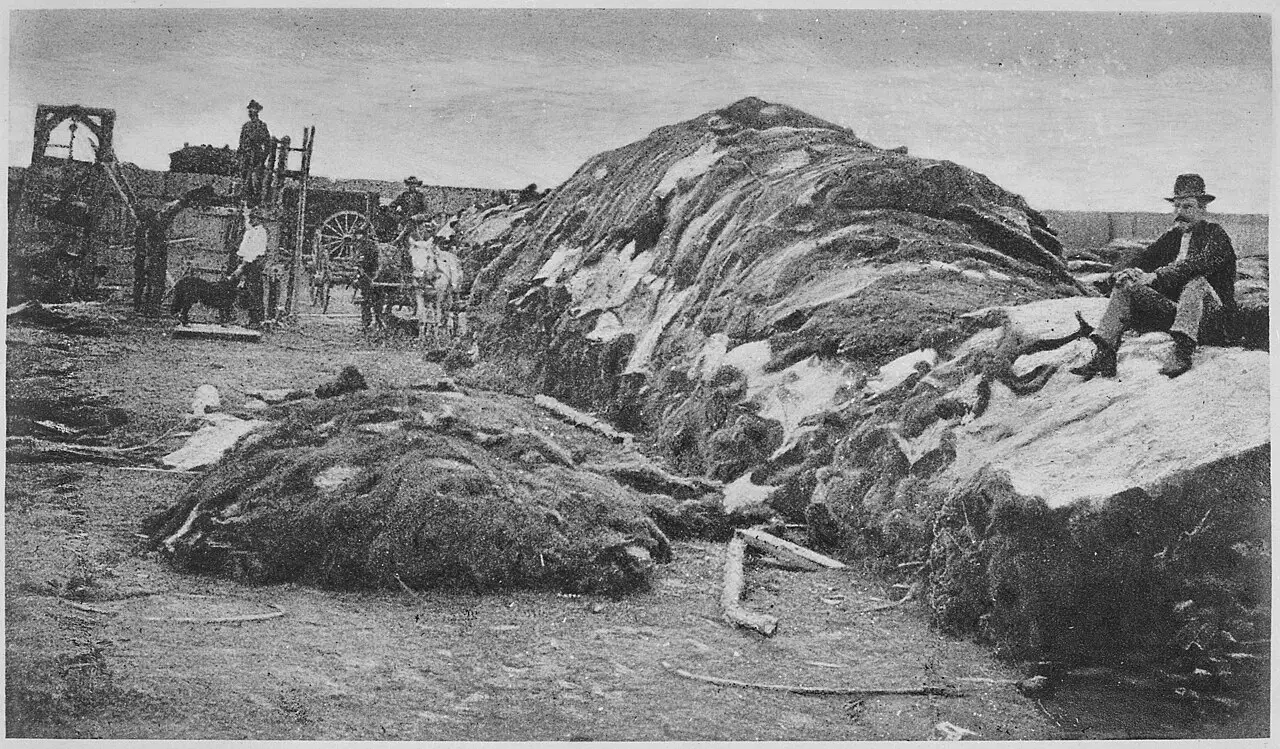
Dodge City was staked out in 1872 beside Fort Dodge, which protected the Santa Fe Trail. The Santa Fe Railroad arrived that September. Its first trade was in buffalo hides and bones. In 1876 Kansas moved its cattle quarantine line west, cutting off Abilene and other older cow towns, and Dodge City became the "queen of the cow towns", fed by the Great Western Cattle Trail. Wyatt Earp served there as assistant city marshal. The town claimed more gunfighters than any other in the West, and the Long Branch Saloon became famous. The cattle trade peaked in 1883–84. In 1885 the quarantine line was extended across the whole state, which all but closed the trail. The original "Boot Hill" burials had already been moved in 1878.
Deadwood, Dakota Territory
Deadwood grew up illegally on land guaranteed to the Lakota by the 1868 Treaty of Fort Laramie. The Black Hills are sacred to the Lakota. After George Armstrong Custer's 1874 expedition announced gold, prospectors poured in, and the Black Hills Gold Rush made the camp's heyday 1876–79. Population estimates range from about 12,000 to 25,000 and are uncertain. On 2 August 1876 Jack McCall shot Wild Bill Hickok dead at a card table. McCall was acquitted by a miners' court, then retried in a Dakota Territory court because the town had no legal standing, and hanged. Hickok and Calamity Jane lie in Mount Moriah Cemetery. A fire on 26 September 1879 destroyed more than 300 buildings. The whole town became a National Historic Landmark in 1961, and South Dakota legalised gambling there in 1989 to pay for preservation.
Abilene, Kansas
Abilene was the first great cow town. In 1867 the Kansas Pacific Railway reached it, and the cattle dealer Joseph G. McCoy built stockyards and the Drover's Cottage hotel. He persuaded Texans to drive their herds up the Chisholm Trail, which ended at Abilene from 1867 to 1871. Its marshals included Tom "Bear River" Smith, murdered in 1870, and Wild Bill Hickok. When the quarantine line moved, the trade moved on, and Abilene later became best known as the boyhood home of Dwight D. Eisenhower.
Key facts
- Tombstone: silver found 1877; town founded 1879; O.K. Corral gunfight 1881; 2020 population 1,308
- Dodge City: founded 1872; leading cow town from about 1876 to 1885
- Deadwood: gold-rush boom 1876–79; Hickok killed 2 August 1876
- Abilene: railhead from 1867; end of the Chisholm Trail 1867–71
- Typical businesses: saloons, gambling halls, theatres, brothels, stockyards, assay offices
- A cattle town lay where a railroad met a livestock trail, and Texas herds were sold and shipped from there
- Abilene, Kansas, became the first cattle town in 1867
- Ellsworth, Newton and Wichita took over the trade in 1872; settlement closed them to it by 1875
- Dodge City, the "Cowboy Capital" and "Queen of the Cowtowns", was the main cattle town from about 1876 to 1885
- Kansas banned the import of Texas cattle in 1885, ending the trade at Dodge City and Caldwell
- Boomtowns grew suddenly after discoveries of resources such as gold, silver or oil
- Wyatt Earp, the Mastersons and Doc Holliday all spent time in Dodge City (Kansas Historical Society)
- Tombstone, Arizona: Ed Schieffelin found silver there in 1877; by 1881 a silver rush had brought about 7,000 people, and the boom ended by 1911 with flooded mines, strikes and low silver prices (Britannica)
See also
Sources
- Cattle town - Wikipedia en.wikipedia.org
- Boomtown - Wikipedia en.wikipedia.org
- Cowtowns - Kansapedia, Kansas Historical Society kansashistory.gov
- Dodge City, Ford County - Kansapedia, Kansas Historical Society kansashistory.gov
- Cattle Towns - Encyclopedia of the Great Plains plainshumanities.unl.edu
- Tombstone, Arizona - Britannica britannica.com
- Tombstone, Arizona - Wikipedia en.wikipedia.org
- Dodge City, Kansas - Wikipedia en.wikipedia.org
- Deadwood, South Dakota - Wikipedia en.wikipedia.org
- Abilene, Kansas - Wikipedia en.wikipedia.org
- Wikimedia Commons: %22Rath %26 Wright%27s buffalo hide yard in 1878, showing 40,000 buffalo hides, Dodge City, Kansas.%22 - NARA - 520093.jpg commons.wikimedia.org