
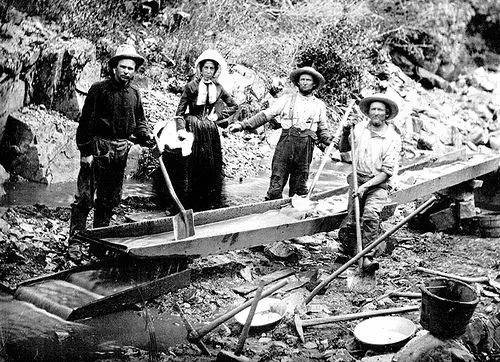

The California Gold Rush began after James W. Marshall found gold at Sutter's Mill in Coloma in January 1848. News of the find set off one of the largest mass migrations in American history: around 300,000 people came to California by sea and overland. The rush sped up California's admission as a state in 1850 and created instant towns and fortunes, though few miners actually got rich. For Native Californians it brought a steep fall in population and the loss of much of their land.
The discovery
On 24 January 1848, Marshall, who was building a lumber mill for the settler John Sutter on the American River at Coloma, spotted flakes of gold in the mill's tailrace. Sutter tried to keep the find quiet, but word spread. California was then just passing from Mexican to US control: the Treaty of Guadalupe Hidalgo, which ended the Mexican–American War, was signed only days later, in February 1848.
The forty-niners
The news reached the eastern states during 1848, and President James K. Polk confirmed it in a message to Congress that December. In 1849 fortune-seekers poured in, and they became known as the "forty-niners". They came by three main routes:
- overland by wagon, along the California Trail
- by ship around the tip of South America, a voyage of four to five months
- by ship to Panama, across the isthmus, and by ship again to San Francisco
Many came not only from the United States but from Latin America, Europe, Australia and China. San Francisco grew from a small settlement into a boom city almost overnight, and the harbour filled with ships abandoned by crews who had run off to the diggings.
Life in the diggings
Early miners panned or used simple rockers and sluices to wash gold from stream gravels. Mining camps sprang up quickly, with saloons, gambling halls and improvised justice. They were forerunners of the boom-and-bust frontier towns that followed later strikes across the West, including the silver boom that created Tombstone.
As the easy surface gold ran out, mining became an industry using hydraulic hoses, dams and hard-rock shafts, run by companies with paid workers rather than lone prospectors. Foreign miners faced discrimination, including a foreign miners' tax passed by the new state legislature, which fell mainly on Latin American miners; Chinese miners also met growing hostility.
Winners and losers
An estimated $2 billion in gold was extracted, yet few prospectors struck it rich. More dependable fortunes went to merchants who sold supplies, food and transport. Sutter himself did not profit: his workers deserted and squatters overran his land, and he was bankrupt by 1852.
The gravest cost fell on California's Native peoples. Their numbers fell from perhaps 150,000 in 1848 to about 30,000 by 1870, through disease, hunger, the loss of land and food sources, and violence. Some Native Californians raided livestock and attacked miners, settlers and travellers, and these attacks were often answered by militia expeditions and reprisal killings that fell on whole villages. An 1850 state law allowed Native children, and Native adults judged to be vagrants, to be bound out as unpaid labourers. In January 1851 Governor Peter Burnett told the legislature that "a war of extermination will continue to be waged between the races until the Indian race becomes extinct", an outcome he said he expected "with painful regret". Estimates of the number of Native people killed by settlers, militia and soldiers between 1846 and 1873 range from a few thousand to about 16,000. Accounts differ, and historians still debate how these events should be described. Some settlers spoke out at the time: in 1860 the young newspaperman Bret Harte condemned the killing of Wiyot women and children near Humboldt Bay, and left the town soon afterwards amid threats.
Statehood and end of the rush
California never became a formal territory. The surge in population let it move quickly to statehood, and it was admitted on 9 September 1850 under the Compromise of 1850.
When the rush ended is disputed between sources. Accounts differ: some date it roughly 1848–1855, others say it peaked in 1852 and was over by the end of the decade (about 1859). Either way, the individual prospector's rush gave way to industrial mining within a few years.
Legacy
The Gold Rush helped fix the idea of the West as a land of sudden fortune. Its money and population fed the demand for faster links east, including the Pony Express and the transcontinental railroad. On screen it inspired films such as the musical Paint Your Wagon (1969), and mining-camp conflict is central to Pale Rider (1985).
Key facts
- Started: 24 January 1848, Sutter's Mill, Coloma, California
- Discoverer: James W. Marshall
- Migrants: about 300,000
- Nickname for arrivals: forty-niners
- Peak: 1852
- End: c. 1855 or c. 1859, disputed
- Gold extracted: an estimated $2 billion
- Statehood: California admitted under the Compromise of 1850
- Gold found on 24 January 1848 by James W. Marshall at Sutter's Mill, Coloma
- About 300,000 people came to California during the rush
- Newcomers of 1849 were called "forty-niners"
- Peaked in 1852 and was over by the end of the decade (Britannica)
- An estimated $2 billion in gold was extracted, but few prospectors struck it rich (Britannica)
- John Sutter was bankrupt by 1852 (Britannica)
- California became a state under the Compromise of 1850
See also
Sources
- California gold rush - Wikipedia en.wikipedia.org
- California Gold Rush - Britannica britannica.com
- Wikidata: Q17550 wikidata.org
- Wikimedia Commons: 1850 Woman and Men in California Gold Rush.jpg commons.wikimedia.org
- Gov. Peter H. Burnett, State of the State address to the California Legislature, 6 Jan 1851 – California State Library, Governors' addresses governors.library.ca.gov
- California Militia and Expeditions Against the Indians, 1850–1859 – California State Military Museum (quotes Burnett's 1850 militia orders for the Gila and Ringgold attacks) militarymuseum.org
- Bret Harte, 'Indiscriminate Massacre of Indians, Women and Children Butchered', The Northern Californian (Union/Arcata), 29 Feb 1860, p. 2 – transcription, Northwestern California Genocide Project (Cal Poly Humboldt) nwgenocide.omeka.net
- Kimberly Johnston-Dodds, Early California Laws and Policies Related to California Indians (Sacramento: California Research Bureau, CRB-02-014, Sept 2002) library.ca.gov
- Sherburne F. Cook, The Conflict Between the California Indian and White Civilization (Berkeley: University of California Press, 1943) – Internet Archive archive.org
- Benjamin Madley, An American Genocide: The United States and the California Indian Catastrophe, 1846–1873 (New Haven: Yale University Press, 2016) yalebooks.yale.edu
- Gary Clayton Anderson, 'The Native Peoples of the American West: Genocide or Ethnic Cleansing?', Western Historical Quarterly 47:4 (2016), 407–434 doi.org