
Jupiter
Explore this trainInteractive cutaway, parts and steam tourExplore in 3DTurn her round, exploded view, parts list (about 2.8 MB)
The Jupiter, officially Central Pacific Railroad No. 60, was a wood-burning 4-4-0 steam locomotive that took part in one of the great moments of the Old West. On 10 May 1869 it stood nose to nose with the Union Pacific's No. 119 at Promontory Summit, Utah Territory, while the golden spike was driven to complete the first transcontinental railroad. The engine itself was later scrapped, but a working full-size replica now runs at Golden Spike National Historical Park.
Building and delivery
The Jupiter was built in September 1868 by the Schenectady Locomotive Works in New York State, one of four identical engines ordered by the Central Pacific Railroad. Its sisters were named Storm, Whirlwind and Leviathan and numbered 61 to 63. With no railway yet across the continent, the engines had to be taken apart and shipped by sea to San Francisco, then carried by river barge to the company's headquarters at Sacramento. The Jupiter was put back together and entered service on 20 March 1869, less than two months before the lines met.
Like most American engines of its day it was a "4-4-0", sometimes called the American type: four small leading wheels to guide it round curves, four large driving wheels and no trailing wheels. It burned wood, which is why it carried the big balloon-shaped smokestack that catches sparks and appears in so many pictures of the early Western railways.
The road to Promontory
The Jupiter worked on the Central Pacific's eastern division, pulling passenger, goods and construction trains between Toano, Nevada, and the end of track. It was never meant to be the ceremonial engine. When the special train carrying the Central Pacific's president, Leland Stanford, reached Toano on its way to the ceremony, its own locomotive was taken off for other work and the Jupiter was coupled on for the last leg of the journey.
So it was the Jupiter that faced the Union Pacific's No. 119 across the final gap in the rails. In Andrew J. Russell's famous photograph of the "meeting of the rails", the two engines stand pilot to pilot while workmen crowd around them, and the two engineers reach out towards each other with bottles of champagne. That picture made the engine one of the best-known locomotives in American history.
Later years
After the celebrations the Jupiter went back to everyday work. In the 1870s the Central Pacific stopped naming its engines, and it became plain No. 60. It was rebuilt over the years with a new boiler, smokestack and other parts. After the Southern Pacific took over the Central Pacific it was renumbered 1195 in 1891, converted to burn coal in 1893 and sold that year to the Gila Valley, Globe and Northern Railway in Arizona, where it became No. 1. It was sold for scrap in 1909. Nobody at the time seems to have thought it worth saving.
Replicas and the screen
For years other old engines were dressed up to play the Jupiter. Virginia and Truckee Railroad locomotives such as the Genoa and Inyo stood in for it at fairs and anniversaries, and the Inyo played it in Cecil B. DeMille's Union Pacific (1939). John Ford also staged the Golden Spike ceremony in The Iron Horse (1924).
For the ceremony's centenary the National Park Service decided to build exact replicas of both engines. No plans of the originals survived, so engineers worked out hundreds of new drawings from photographs and from research into similar engines of the 1860s. The replicas of the Jupiter and No. 119 were finished in 1979 and first steamed at Promontory on 10 May that year, 110 years after the original meeting. The Jupiter replica was later converted to burn wood, like the original, and in 1994 it was repainted in blue, crimson and gold after a description of the engine's colours turned up in an 1869 newspaper. The two engines still make demonstration runs at the park and re-enact the meeting of the rails.
Key facts
- Railway: Central Pacific Railroad, No. 60
- Type: 4-4-0 "American", wood-burning
- Built: September 1868, Schenectady Locomotive Works
- Entered service: 20 March 1869
- Famous for: the Golden Spike ceremony, Promontory Summit, 10 May 1869
- Fate: sold for scrap in 1909; a working replica was built in 1979
- Country: United States (Wikidata P17)
- Instance of: tender locomotive (Wikidata P31)
- Built September 1868, commissioned 20 March 1869 (Wikipedia)
- Wikidata P571 gives 1909 (not the build date)
Inside and out: original illustrations
These drawings of Jupiter were made for TheFrontierWiki from the engine's published dimensions and period descriptions. No photograph or drawing was traced. Some measurements, such as the tender's, are estimates, and the exact placement of the colours is a reconstruction from 1869 descriptions of her blue, crimson and gold paint.
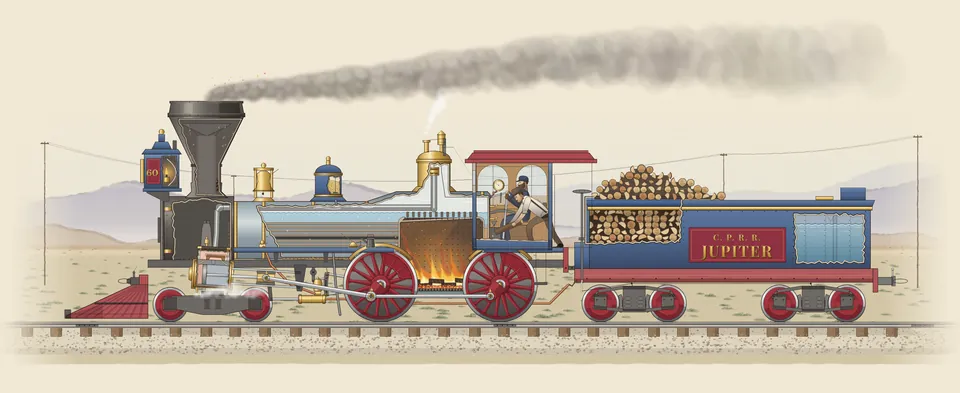 Explore Jupiter, inside and outTap any of the 72 numbered parts, peel the engine open to watch the fire and steam at work, or take a six-step tour of how steam makes her go.Open the interactive explorer ›
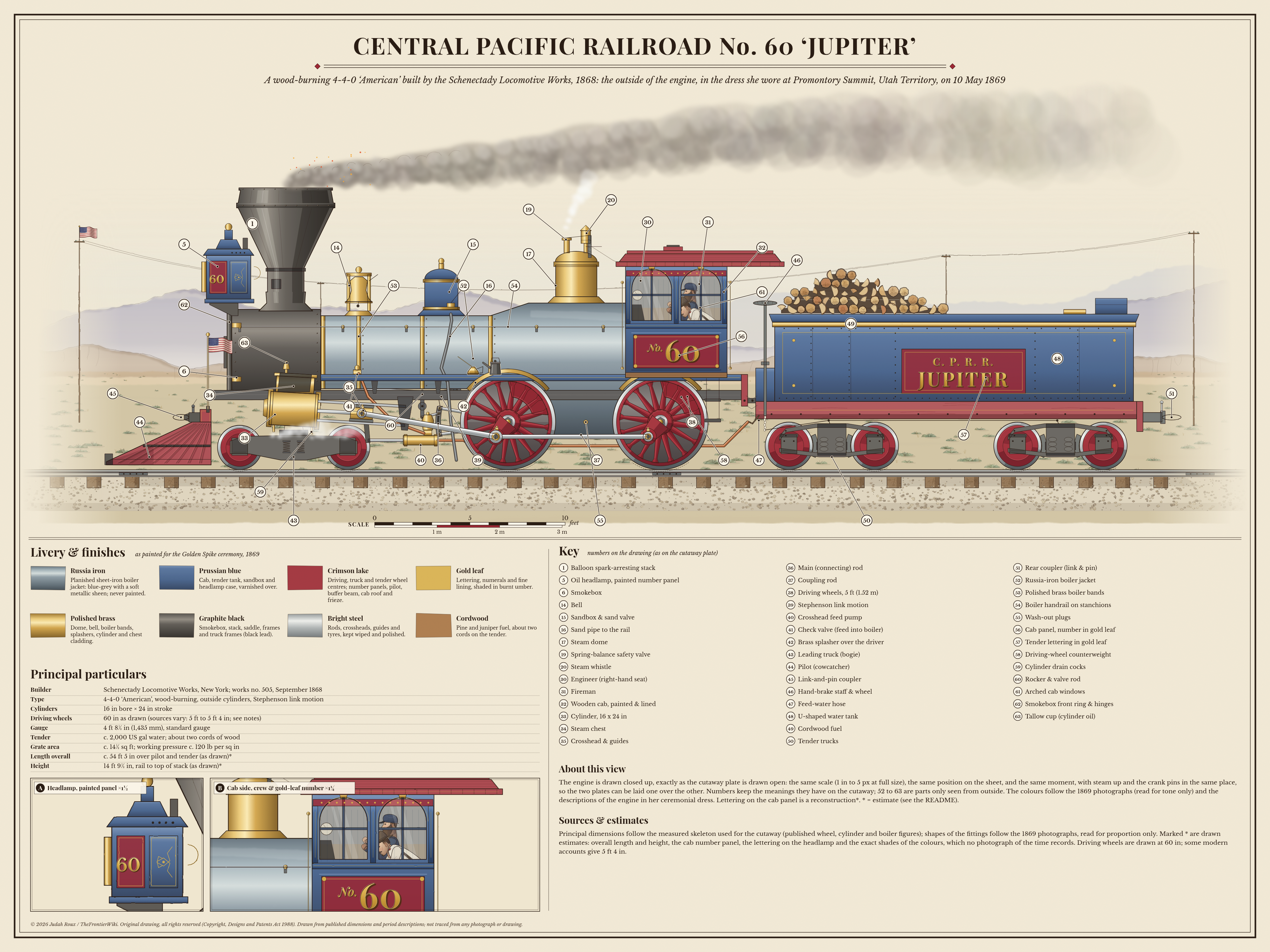
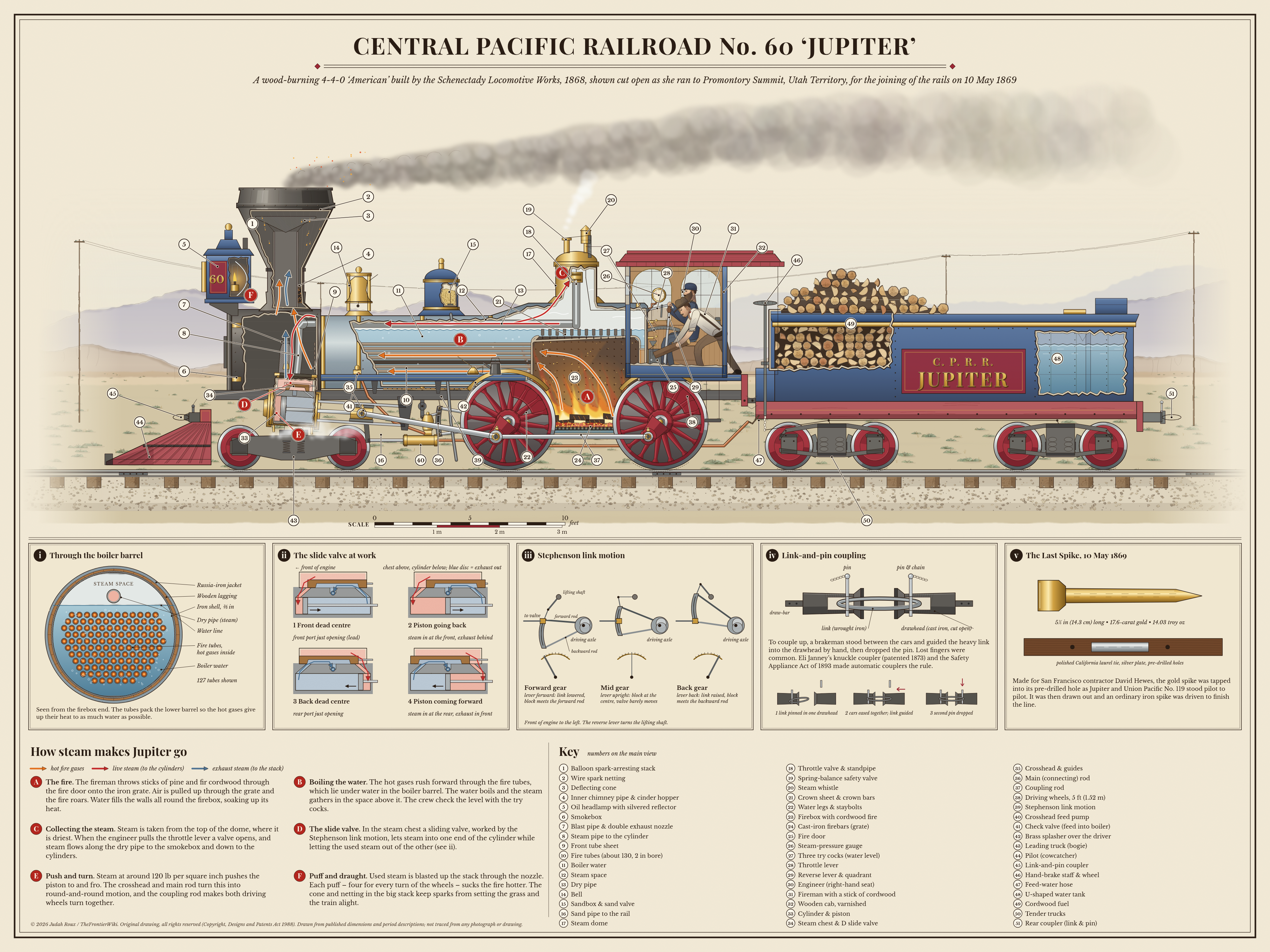
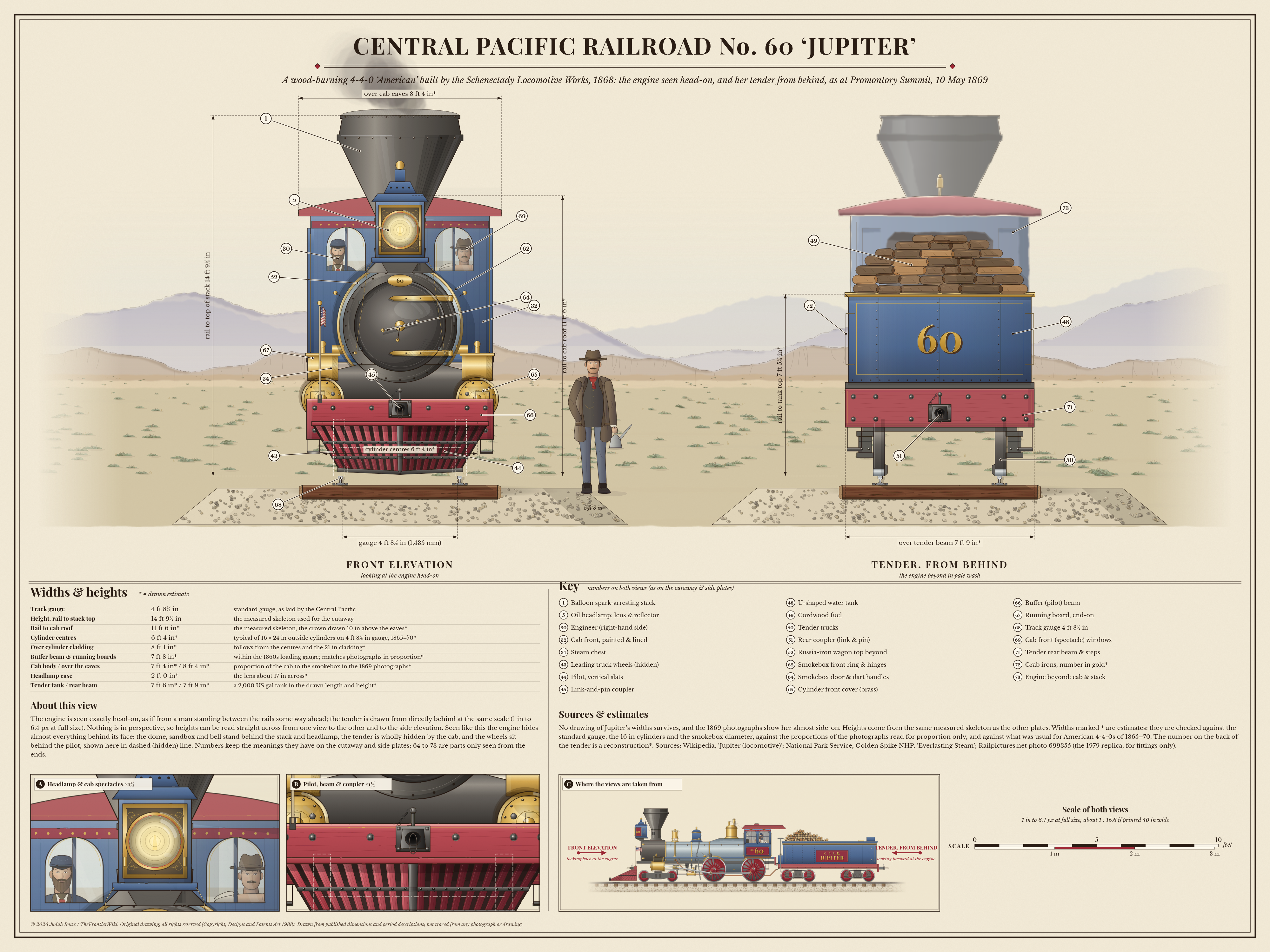
© 2026 Judah Roux / TheFrontierWiki. Original artwork; all rights reserved.
See also
Gallery 1


Appears in 2


Sources
- Jupiter (locomotive) - Wikipedia en.wikipedia.org
- Wikidata: Q6314572 wikidata.org
- Wikimedia Commons: 69workmen.jpg commons.wikimedia.org
- Wikimedia Commons: CP steam loco.jpg commons.wikimedia.org
