
Las Vegas, New Mexico
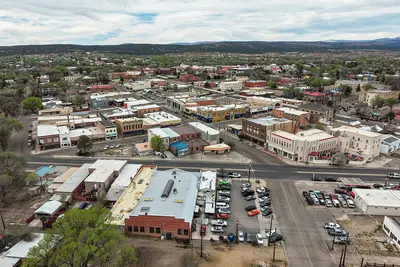
Las Vegas is an old town in north-eastern New Mexico, on the Gallinas River where the plains meet the foothills of the Sangre de Cristo Mountains. It was founded in 1835 by settlers from the Mexican province of New Mexico on a land grant from the Mexican government, and it grew into one of the busiest stops on the Santa Fe Trail. In August 1846 General Stephen W. Kearny stood on a rooftop on its plaza and claimed New Mexico for the United States. When the Santa Fe railway arrived in 1879 a new railway town grew up beside the old Hispanic plaza, and for a few years Las Vegas was one of the liveliest and roughest towns in the West. It is the county seat of San Miguel County and the home of New Mexico Highlands University.
The plaza town
The Las Vegas grant was made by the Mexican government in 1835 to a group of settlers. (The land had earlier been granted to Luis María Cabeza de Baca, whose heirs were later given other land instead.) The settlers laid out their town in the Spanish colonial manner, around a central plaza lined with flat-roofed adobe buildings that could serve as a fort if the town was attacked. The trail ran straight through the plaza, and for traders coming from Missouri, Las Vegas was the first Mexican town of any size on the road to Santa Fe.
Kearny's proclamation
In August 1846, early in the Mexican–American War, Kearny's Army of the West marched down the Santa Fe Trail into New Mexico. On 15 August, at Las Vegas, he is thought to have climbed onto a flat roof on the north side of the plaza to address the alcalde and the townspeople. He told them that he came as a protector, not a conqueror, released them from their allegiance to Mexico, and promised that those who stayed peaceably at home would be protected in their persons, their property and their religion, and that his troops would take nothing without paying for it. Knowing that the people were Catholics who had been warned that the Americans would mistreat them, he assured them that his government respected their religion as much as the Protestant faith. Bancroft, writing in 1889, recorded that he made similar speeches at each village on his way to Santa Fe, which he entered without a battle. A marker on the plaza recalls the event.
The railway and the New Town
The Santa Fe railway reached Las Vegas on 4 July 1879. Instead of building through the old town, the railway laid out its station and a "New Town" about a mile to the east, across the Gallinas, and for many years East and West Las Vegas were separate towns. The railway boom brought merchants, ranchers and builders, and with them gamblers, confidence men and gunmen. Among those who passed through in 1879 were Doc Holliday and Wyatt Earp. The Las Vegas Gazette did much to make Billy the Kid famous with its stories about him in December 1880.
By 1889 Bancroft could describe Las Vegas as the third town in New Mexico, with about 6,000 people. A branch line ran six miles to the hot springs in the canyon of the Gallinas, where a resort hotel opened in 1879, and in the same year the first Episcopal church in New Mexico was dedicated at Las Vegas. Italian Jesuits founded Las Vegas College in 1877 (it moved to Denver in 1887 and became Regis University), and the New Mexico Normal School, now New Mexico Highlands University, opened in the 1890s. The Plaza Hotel was built in 1881, and the Castañeda, one of the railway's Harvey House hotels, opened in 1898.
Rough Riders and cowboys
Many of Theodore Roosevelt's Rough Riders, the volunteer cavalry of the Spanish–American War of 1898, were recruited in New Mexico, and the regiment held its first reunion at the Plaza Hotel in June 1899 and chose Las Vegas as its reunion home. The City of Las Vegas Museum and Rough Rider Memorial keeps their story. From 1915 the town also held an annual Cowboys' Reunion, a rodeo and celebration of ranch life put on by local ranching families, which drew stars such as Tom Mix.
Legend and history
- The lawless years. Las Vegas's reputation in 1879–1881 was well earned, but it is easy to exaggerate. Many of the famous names said to have been there only passed through, and the town's long history as a farming, trading and church community began decades before the railway.
- Two towns. The old Hispanic plaza town and the Anglo railway town were rivals for many years, and they still keep separate school districts.
In Westerns
The old buildings of Las Vegas have made it a popular film location. Much of No Country for Old Men (2007) was filmed in and around the town, and it stood in for Wyoming in the television series Longmire.
Key facts
- Location: San Miguel County, north-eastern New Mexico, on the Gallinas River
- Founded: 1835, on a Mexican land grant
- Trail: Santa Fe Trail
- Kearny's proclamation: 15 August 1846
- Railway arrived: 4 July 1879
- Population in 1889: about 6,000 (Bancroft)
- University: New Mexico Highlands University
- Founded/established: 1835 (Wikidata P571)
- Country: United States (Wikidata P17)
- Located in: San Miguel County (Wikidata P131)
- Instance of: city in the United States, county seat (Wikidata P31)
See also
Nearby
- Fort Union National Monument 39 km
- Fort Sumner 163 km
- Lincoln, New Mexico 235 km
- Fort Stanton 235 km
- Tascosa, Texas 269 km
Gallery 1

Sources
- Las Vegas, New Mexico - Wikipedia en.wikipedia.org
- Wikidata: Q676171 wikidata.org
- Wikimedia Commons: Downtown Las Vegas, NM.JPG commons.wikimedia.org
- Wikimedia Commons: Las Vegas, New Mexico.jpg commons.wikimedia.org
