
Leadville, Colorado
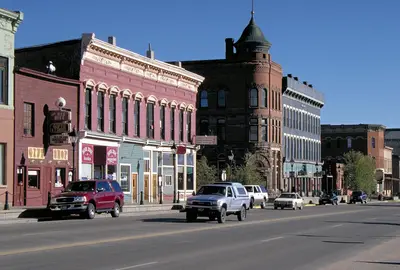
Leadville is an old silver-mining town high in the Colorado Rockies, at the head of the Arkansas River. At more than 10,000 feet above sea level it is the highest incorporated city in the United States. Gold brought the first prospectors in 1860, but the town itself was born in a great silver boom in the late 1870s, when it grew in two years from a few hundred people to some 30,000 and became, after Denver, the largest city in Colorado. It made the fortunes of men such as Horace Tabor, and its historic district is now a National Historic Landmark.
Gold in California Gulch
The Ute people had long hunted in the upper Arkansas valley. In April 1860, during the Pike's Peak gold rush, a prospector named Abe Lee found gold in a gulch that was soon called California Gulch, said to be from his cry that he had found "all California" in his pan. By the end of that summer some 10,000 people were working along the gulch, and a camp called Oro City grew up. More than $3 million in gold was washed out by 1865, but once the easy gold was gone the camp almost emptied.
The silver boom
The few miners who stayed cursed the heavy black sand that clogged their sluices. In 1874 William Stevens and Alvinus Wood found that it was lead carbonate rich in silver. They quietly staked claims across the hills before announcing the find in 1876. In 1877 August Meyer of the St Louis Smelting and Refining Company built a smelter and roads, a post office opened under the name Leadville, and the boom began.
Leadville was incorporated at the start of 1878 with a few hundred residents; by the end of 1879 it had about 30,000. A handful struck it rich. The storekeeper Horace Tabor grubstaked two prospectors, George Hook and August Rische, in return for a share of whatever they found, and their Little Pittsburg mine made him a millionaire. He went on to buy the Chrysolite and Matchless mines, built the Tabor Opera House in 1879 and became lieutenant governor of Colorado. Most newcomers, though, worked for wages of two to three and a half dollars a day in mines owned by others.
Boomtown life
The town went up almost overnight in tents, shacks and log cabins, with Irish, German, Cornish, Jewish and African-American neighbourhoods. It soon had a name for vice: by one count it had 120 saloons, 115 gambling houses and 35 brothels, most of them along State Street. Yet churches, schools, banks and a hospital opened in 1878, the first year of the boom, and newspapers, theatres and fine houses followed. The railway arrived in 1880.
Miners struck for better pay in 1880, and the governor declared martial law to protect the mines. Another long strike in 1896–97 was also broken. The crash of 1893, when the price of silver collapsed, closed most of the mines and ruined Tabor, but Leadville recovered by mining gold, lead, zinc and other metals, and later the great molybdenum mine at nearby Climax kept the town alive.
Famous names
- Doc Holliday. The gambler and gunfighter Doc Holliday lived in Leadville from 1882. In August 1884 he shot and wounded a bartender, Billy Allen, who had threatened him over a small debt, and a jury acquitted him on grounds of self-defence.
- Margaret Tobin Brown. The Missouri-born Margaret Tobin married the mining man James J. Brown in Leadville in 1886. Years later, as a survivor of the Titanic, she became famous as "the Unsinkable Molly Brown".
- Baby Doe Tabor. Horace Tabor divorced his first wife to marry the young Elizabeth "Baby Doe" McCourt in 1883. After he died penniless in 1899, she lived for decades in a cabin at the Matchless mine and was found dead there, frozen, in 1935.
Legend and history
- "Please do not shoot the pianist." The Irish writer Oscar Wilde lectured in Leadville in 1882 and later wrote that he had seen this sign over the piano in a saloon: "Please do not shoot the pianist. He is doing his best." The story comes only from his own account.
- The richest camp. Leadville is often called the richest silver camp in the world. It was among the very richest, but such claims were the boasts of the boom years.
- The Tabors. The story of Horace and Baby Doe Tabor, from rags to riches and back, became the subject of books, films and an opera, The Ballad of Baby Doe (1956). Many of the details in those versions are romanticised.
Key facts
- Location: Lake County, Colorado, at 10,152 feet
- First gold: California Gulch, April 1860
- Silver boom: from 1877; incorporated 1878
- Peak population: about 30,000 (1879–80)
- Status: Leadville Historic District, a National Historic Landmark (1961)
- Founded/established: 1877 (Wikidata P571)
- Country: United States (Wikidata P17)
- Located in: Lake County (Wikidata P131)
- Instance of: city in the United States (Wikidata P31)
See also
Nearby
- Central City, Colorado 91 km
- Cripple Creek, Colorado 111 km
- Silverton, Colorado 199 km
- Cheyenne, Wyoming 246 km
- Durango and Silverton Narrow Gauge Railroad 257 km
- Durango, Colorado 259 km
Gallery 2



Sources
- Leadville, Colorado - Wikipedia en.wikipedia.org
- Wikidata: Q286702 wikidata.org
- Wikimedia Commons: Leadville CO - snow.jpg commons.wikimedia.org
- Wikimedia Commons: Co leadville2.jpg commons.wikimedia.org
- Wikimedia Commons: DowntownLeadvilleCO.jpg commons.wikimedia.org
