
Western saloon
The Western saloon was the drinking house of the American frontier, serving trappers, cowboys, miners, soldiers, gamblers and railway men. Often among the first buildings in a new town, a saloon was a bar, a social club, a gambling hall and sometimes a courtroom, church hall or theatre all at once. It became one of the most familiar settings in Western films and fiction.
Beginnings
The word comes from the French salon, a hall. Early drinking places in the West went by many names. As mining camps, cattle towns and railway towns sprang up, saloons followed, and by 1880 a town such as Leavenworth, Kansas, had about 150 of them.
What a saloon was like
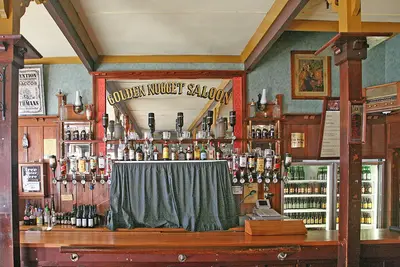
Saloons ranged from a tent with a plank laid across two barrels to grand halls with carved wooden bars, mirrors, chandeliers and paintings. Whiskey was the usual drink, and much of it was rough, home-made stuff known as "rotgut" or "firewater"; beer became common once ice and the railways made it easier to supply. Many saloons offered a free lunch to customers who bought a drink.
Gambling was a big part of the business, with card games such as faro and poker, and some saloons were little more than gambling dens. Others offered music, dancing and stage shows. The swinging half-doors seen in so many films, often called batwing doors, did exist, but many saloons simply had ordinary doors.
Famous saloons
Some saloons became legends in their own right. The Long Branch in Dodge City, the Oriental and the Bird Cage Theatre in Tombstone, and the No. 10 Saloon in Deadwood, where Wild Bill Hickok was shot in 1876, are among the best known. In West Texas, Judge Roy Bean held court in his own saloon, the Jersey Lilly.
Documented history and legend
Saloon gunfights were far rarer than films suggest. Many towns banned the carrying of guns inside town limits, and the real dangers of saloon life were more often drink, gambling debts and brawls than duels at the bar.
See also
Key facts
- Country: United States, Confederate States of America (Wikidata P17)
Gallery 2


Sources
- Western saloon - Wikipedia en.wikipedia.org
- Wikidata: Q1422401 wikidata.org
- "Ogallala - Nebraska's Cowboy Capital," Nebraska History (1947) history.nebraska.gov
- Cambridge Dictionary, "saloon" dictionary.cambridge.org
- Kansas Historical Society, online exhibit "Sinners and Saints" part 4 kansashistory.gov
- PBS American Experience, "Gaming and Entertainment in Gold Rush Towns" pbs.org
- HistoryNet, "Gambling in the Old West" historynet.com
- Wikimedia Commons: 1897 Saloon Blackhawk.jpg commons.wikimedia.org
- Wikimedia Commons: 00 1230 Shantytown Heritage Park - New Zealand.jpg commons.wikimedia.org
- Wikimedia Commons: Judge Roy Bean.jpg commons.wikimedia.org
