
Rhyolite, Nevada
Rhyolite is a ghost town in the Bullfrog Hills of Nye County, Nevada, about 120 miles north-west of Las Vegas and just outside Death Valley National Park. It is one of the last of the great Western gold-rush towns: it sprang up in 1905, became a modern little city with electric lights and a stock exchange within two years, and was almost empty by 1920. Its ruins are now among the most photographed in the West.
The Bullfrog strike
On 9 August 1904 two prospectors, Frank "Shorty" Harris and Ernest "Ed" Cross, found gold on a hill in south-western Nevada. Harris later said the green rock, spotted with yellow metal, looked like the back of a frog, so they called their claim the Bullfrog. The name spread to the whole district, and most of its 200 or so mining companies worked "Bullfrog" into their own names.
Rhyolite, named after the pale volcanic rock of the hills, grew up next to the most promising mine, the Montgomery-Shoshone. It began as a two-man camp in January 1905 and had about 1,200 people within two weeks.
A boomtown with every comfort
In 1906 the steel magnate Charles M. Schwab bought the Montgomery-Shoshone and spent heavily on it. He had water piped in, paid for an electric line from a hydro-electric plant 100 miles away in the Sierra Nevada, and arranged a railway spur to the mine. Three railways eventually reached the town, the first trains of the Las Vegas and Tonopah Railroad arriving in December 1906.
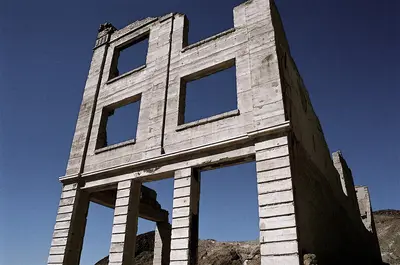
By 1907 Rhyolite had concrete pavements, electric lights, telephones, newspapers, a hospital, a school, an opera house, a public swimming pool, at least three banks and its own mining stock exchange. The grandest building was the three-storey John S. Cook and Co. Bank, finished in 1908 with Italian marble stairs and stained glass. Population figures from the boom are unreliable: some published claims run to 8,000, but historians generally put the peak at between 3,500 and 5,000 in 1907 and 1908. One miner, Tom Kelly, built a house out of about 50,000 empty beer and liquor bottles.
The bust
The rich ore proved to lie in only a few narrow seams; what Schwab had really bought, he admitted, was a large low-grade mine. The 1906 San Francisco earthquake and the financial panic of 1907 made money hard to raise, and in 1908 an unfavourable report by a British mining engineer sent the company's shares crashing. The mine closed in March 1911.
The town fell apart almost as fast as it had risen. The banks closed by 1910, the last newspaper by 1912 and the post office in 1913. The last train left in 1914, and the power company took down its lines in 1916. The 1920 census counted 14 people. Whole buildings were carted off to nearby Beatty or broken up for materials.
Ghost town and film location
Rhyolite is now looked after by the Bureau of Land Management. The mission-style railway depot, the shell of the Cook Bank and the Bottle House, which a Paramount company repaired in 1925 to film a silent picture, all still stand, along with a cemetery of wooden grave markers. The ruins have been used as a backdrop for several films since. Just south of the town, the Goldwell Open Air Museum shows modern outdoor sculptures among the desert scrub.
See also
Nearby
- Goldfield, Nevada 96 km
- Calico, California 217 km
- Bodie, California 241 km
Key facts
- Founded/established: 1904 (Wikidata P571)
- Ended/dissolved: 1919 (Wikidata P576)
- Country: United States (Wikidata P17)
- Located in: Nye County (Wikidata P131)
- Instance of: ghost town (Wikidata P31)
Gallery 1

Sources
- Rhyolite, Nevada - Wikipedia en.wikipedia.org
- Wikidata: Q1889901 wikidata.org
- Wikimedia Commons: Rhyolite Train Station 20061124.JPG commons.wikimedia.org
- Wikimedia Commons: Rhyolite2.jpg commons.wikimedia.org
