
Deserters and guerrilla raiders
Usually bad · Part of Frontier folk
Some statements on this page are still being checked and are marked "Needs further sources".
The Civil War left the border country full of armed men who had learned to raid, and the Western uses them as some of its cruellest villains.
In classic Westerns
Guerrilla raiders, pro-Confederate bushwhackers or pro-Union Redlegs and jayhawkers, burn farms and kill civilians under cover of the war, and some carry on as outlaws after it. Classic films usually show one side's raiders through the eyes of the other: in The Outlaw Josey Wales (1976) Union-aligned Redlegs murder the hero's family, while Dark Command (1940) is loosely based on Quantrill's pro-Confederate raiders. The deserter is a lesser type: a soldier who runs from his post, often turning outlaw or renegade.
- Look: Mixed civilian and army clothes, several revolvers, burnt farms behind them.
- Values: Revenge, loot and the war as an excuse.
- Role in the story: The men who start the hero's quest for justice.
Sub-types
Bushwhackers and guerrillas
Irregular raiders of the Missouri–Kansas border war and their post-war outlaw heirs.
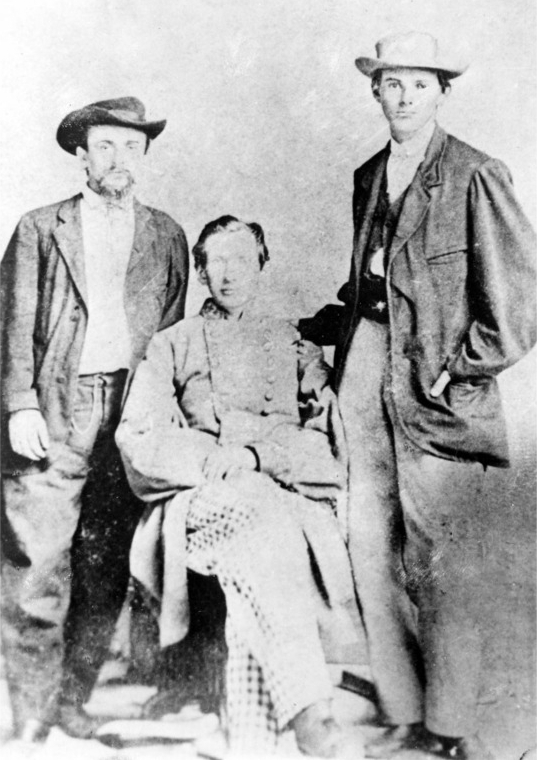
A wartime group portrait of about 1864, titled in its archive record as Frank and Jesse James with Charles Fletcher Taylor.
Posed photograph · Unknown · c.1864 · Source: https://commons.wikimedia.org/wiki/File:James_Brothers_and_Charles_Fletcher_Taylor.jpg · Licence: Public domain – UK: author unknown and work made/published more than 70 years ago (CDPA 1988 s.12(3)) · Small copy; identifications from the archive title only.

Army deserters
Soldiers who desert, either turning outlaw or being hunted down.
In history
Documented history from period sources. The film portrayal is described above under "In classic Westerns"; this section is kept separate.
In western Missouri and eastern Kansas, "jayhawkers" and "border ruffians" fought a guerrilla war for years before the Civil War. A writer of 1907 names Lane and John Brown on one side and Quantrill and Hamilton on the other, and traces the James and Younger brothers to that "school of guerrilla warfare". Wild Bill Hickok first fought under Jim Lane. (Needs further sources: one later, moralising source; the names need second sources.)
How the films differ
Films usually take one side of the border war. The period writer names raiders on both sides.
Films
| # | Film | How it qualifies | From the wiki's summary |
|---|---|---|---|
| 1 | Dances with Wolves (1990) | Army deserters | A Union army lieutenant posted to the frontier comes to live among the Lakota. |
| 2 | The Outlaw Josey Wales (1976) | Bushwhackers and guerrillas | A Missouri farmer whose family is killed during the Civil War becomes a feared gunfighter seeking revenge. |
| 3 | In a Valley of Violence (2016) | Army deserters | A drifter and his dog arrive in a nearly deserted town, where a run-in with the marshal's son leads to bloodshed. |
| 4 | Ride with the Devil (1999) | Bushwhackers and guerrillas | Ang Lee's revisionist Civil War Western follows young men who join the pro-Confederate Bushwhackers fighting the Union-aligned Jayhawkers in Missouri. |
| 5 | Dark Command (1940) | Bushwhackers and guerrillas | Dark Command (1940) is a Western directed by Raoul Walsh from W. R. Burnett's novel, loosely based on Quantrill's Raiders, starring Claire Trevor and John Wayne with Walter Pidgeon, Roy Rogers and Marjorie Main. |
| 6 | The Deadly Companions (1961) | Army deserters | The Deadly Companions (1961) is a Western that marked Sam Peckinpah's debut as a feature director, starring Maureen O'Hara, Brian Keith, Steve Cochran and Chill Wills. |
| 7 | Alvarez Kelly (1966) | Bushwhackers and guerrillas | Alvarez Kelly (1966) is a Civil War Western directed by Edward Dmytryk, starring William Holden as the Mexican cattleman Alvarez Kelly and Richard Widmark as Colonel Tom Rossiter. |
| 8 | The Stranger Wore a Gun (1953) | Bushwhackers and guerrillas | The Stranger Wore a Gun (1953) is a 3D Western directed by Andre de Toth, starring Randolph Scott as a former Confederate spy for Quantrill who moves to Arizona to join a gold robbery but has second thoughts, with Claire Trevor. |
| 9 | Kansas Raiders (1950) | Bushwhackers and guerrillas | Kansas Raiders (1950) is a Civil War Western directed by Ray Enright, starring Audie Murphy as Jesse James, who falls under the influence of William Quantrill, played by Brian Donlevy. |
| 10 | California (1947) | Army deserters | California (1947) is a Western directed by John Farrow, set during the Gold Rush, starring Ray Milland as an army deserter guiding a wagon train, Barbara Stanwyck in her Technicolor debut and Barry Fitzgerald. |
| 11 | Belle Starr (1941) | Bushwhackers and guerrillas | Belle Starr (1941) is a Technicolor Western directed by Irving Cummings for 20th Century Fox, starring Gene Tierney as the outlaw Belle Starr, with Randolph Scott and Dana Andrews. |
| 12 | Red Mountain (1951) | Bushwhackers and guerrillas | Red Mountain (1951) is a Western directed by William Dieterle, set in the final days of the Civil War, starring Alan Ladd as Captain Brett Sherwood, with Lizabeth Scott, Arthur Kennedy and John Ireland as William Quantrill. |
| 13 | Woman They Almost Lynched (1953) | Bushwhackers and guerrillas | Woman They Almost Lynched (1953) is a Western directed by Allan Dwan for Republic Pictures, set on the Arkansas–Missouri border during the Civil War, starring John Lund, Brian Donlevy as Charles Quantrill, Audrey Totter and Joan Leslie. |
| 14 | A Bullet for Sandoval (1969) | Army deserters | A Bullet for Sandoval (1969) is an Italian-Spanish Spaghetti Western directed by Julio Buchs, starring George Hilton as an army deserter and Ernest Borgnine as Don Pedro Sandoval. |
| 15 | Renegade Riders (1967) | Army deserters | Renegade Riders (1967), also known as Payment in Blood, is a Spaghetti Western that was Enzo G. Castellari's official directing debut, starring Edd Byrnes and Guy Madison, about Confederate deserters terrorising villages in Mexico after the Civil War. |
Films are listed in order of popularity, with older classics given extra weight. Information courtesy of IMDb (https://www.imdb.com).
See also
Sources
- The Story of the Outlaw (Emerson Hough), Outing Publishing Company, New York, 1907 (accessed 28 October 2026)