
Cheyenne
Either side · Part of Frontier folk
Some statements on this page are still being checked and are marked "Needs further sources".
The Cheyenne of the central Plains appear in Westerns about the Sand Creek and Washita attacks, the Little Bighorn, and the 1878 flight north.
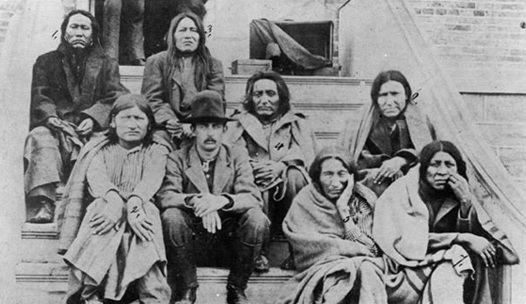
Cheyenne prisoners on the courthouse steps at Dodge City, Kansas, 1879. The photograph's record names them as Tangle Hair, Wild Hog, Strong Left Hand, George Reynolds (interpreter), Old Crow, Noisy Walker, Porcupine and Blacksmith. They were later released.
Posed photograph · Leonard & Martin, Dodge City · 1879 · Source: https://commons.wikimedia.org/wiki/File:Cheyenne-prisoners-Kansas.jpg · Licence: Public domain – UK: author presumed dead more than 70 years ago (CDPA s.57) · Small copy; names as given in the photograph's record.

In classic Westerns
Cheyenne Autumn (1964) tells the Northern Cheyenne flight from the Indian Territory under Little Wolf and Dull Knife. Little Big Man (1970) shows its hero raised among the Cheyenne. Other films name Cheyenne war parties in cavalry stories.
- Naming: Named as the sources and films name them; no generic label is used.
- Role in the story: Varies from film to film: allies, enemies, families, or the centre of the story.
Sub-types
Chiefs and leaders
Named Cheyenne leaders as the films show them.
Scouts and trackers
Cheyenne scouts, trackers and guides, often serving with the army.
Raiding bands (as films show them)
Films that show a Cheyenne war party or raiding band, described in each film's own terms and by its named leader where there is one.
Peoples and families
Films that portray Cheyenne people and their home life, or name the Cheyenne at all.
In history
Documented history from period sources. The film portrayal is described above under "In classic Westerns"; this section is kept separate.
A young traveller in 1846 found half a dozen lodges of friendly Cheyenne camped with the Dakota; the men wore Mexican ponchos with the right arm left bare.
An army officer with General Crook in 1876 records the village of Dull Knife and Little Wolf, and Cheyenne scouts serving with the army. A photograph of 1879 shows Cheyenne prisoners at Dodge City after the flight north of 1878–79.
How the films differ
Films mostly show the Cheyenne as enemies. The period record has friendly camps, Cheyenne scouts with the army, and war.
Films
| # | Film | How it qualifies | From the wiki's summary |
|---|---|---|---|
| 1 | Dances with Wolves (1990) | Raiding bands (as films show them); Peoples and families | A Union army lieutenant posted to the frontier comes to live among the Lakota. |
| 2 | Hostiles (2017) | Chiefs and leaders; Peoples and families | In 1892, a hardened cavalry captain is ordered to escort a dying Cheyenne war chief and his family back to their homeland in Montana. |
| 3 | She Wore a Yellow Ribbon (1949) | Raiding bands (as films show them); Peoples and families | In 1876, a veteran cavalry captain days from retirement leads one last patrol while trouble builds after Custer's defeat. |
| 4 | Cheyenne Autumn (1964) | Chiefs and leaders; Peoples and families | John Ford's last Western dramatises, with some licence, the Northern Cheyenne Exodus of 1878–79. |
| 5 | The Big Trail (1930) | Raiding bands (as films show them); Peoples and families | Raoul Walsh's early sound epic follows a wagon train along the Oregon Trail, with a 23-year-old John Wayne in his first leading role alongside Marguerite Churchill and Tyrone Power Sr. |
| 6 | The Indian Fighter (1955) | Raiding bands (as films show them); Peoples and families | The Indian Fighter (1955) is a CinemaScope Western directed by Andre de Toth, starring Kirk Douglas as the scout Johnny Hawks, with Elsa Martinelli, Walter Matthau and Diana Douglas. |
| 7 | The Iron Horse (1924) | Raiding bands (as films show them); Peoples and families | Fox Film's silent epic was a rushed answer to Paramount's hit The Covered Wagon. |
| 8 | Last of the Dogmen (1995) | Raiding bands (as films show them); Peoples and families | Last of the Dogmen (1995) is a Western written and directed by Tab Murphy, his debut as a director, starring Tom Berenger as bounty hunter Lewis Gates, who tracks escaped convicts into the Montana mountains and finds an unknown band of Cheyenne Dog Soldiers. |
| 9 | The Guns of Fort Petticoat (1957) | Chiefs and leaders; Raiding bands (as films show them); Peoples and families | The Guns of Fort Petticoat (1957) is a cavalry Western directed by George Marshall and produced by Harry Joe Brown and Audie Murphy, who stars as Lieutenant Frank Hewitt, with Hope Emerson. |
| 10 | Buffalo Bill (1944) | Chiefs and leaders; Peoples and families | Joel McCrea plays the frontiersman and showman Buffalo Bill Cody in William A. Wellman's film about his life, with Maureen O'Hara, Linda Darnell and Thomas Mitchell as Ned Buntline. |
| 11 | White Feather (1955) | Peoples and families | White Feather (1955) is a CinemaScope Western directed by Robert D. Webb and filmed in Durango, Mexico, starring Robert Wagner as Josh Tanner, with Jeffrey Hunter and Debra Paget. |
| 12 | Tomahawk (1951) | Raiding bands (as films show them); Peoples and families | Tomahawk (1951) is a Western directed by George Sherman, starring Van Heflin as the frontiersman Jim Bridger and Yvonne De Carlo. |
| 13 | Windwalker (1980) | Raiding bands (as films show them); Peoples and families | An old Cheyenne warrior comes back to life to protect his family from Crow warriors and to find his long-lost son. |
Films are listed in order of popularity, with older classics given extra weight. Information courtesy of IMDb (https://www.imdb.com).
See also
Sources
- The Oregon Trail (Francis Parkman), Project Gutenberg #1015, 1849 (accessed 28 October 2026)
- On the Border with Crook (John G. Bourke, Capt. 3rd Cavalry), Charles Scribner's Sons, New York, 1891 (accessed 28 October 2026)