


✦ Legend
Jesse James was shot dead on 3 April 1882 by Robert Ford, a new member of his own gang, at the house in St. Joseph, Missouri, where he was living under a false name. Ford had made a deal with Missouri's governor, Thomas Crittenden, to collect the reward offered for Jesse's capture.Sources: Jesse James: Topics in Chronicling America (research guide), Library of Congress (accessed 27 October 2026) · Jesse James, State Historical Society of Missouri – Historic Missourians (accessed 27 October 2026) · The Death of Jesse James, PBS American Experience (accessed 27 October 2026)
Jesse Woodson James (1847–1882) was a Missouri outlaw who rode with pro-Confederate guerrillas in the Civil War and then, with his brother Frank, led the James–Younger Gang through a long run of bank, stagecoach and train robberies. Newspapers sympathetic to the defeated South turned him into a Robin Hood figure while he was still alive. He was shot dead in his own home in 1882 by Robert Ford, a new member of his gang who was after the reward. The other side of the story: his gang terrorised civilians and held back Missouri's recovery after the war.
Early life
James was born on 5 September 1847 in Clay County, Missouri, near present-day Kearney, in a region known as "Little Dixie" because so many of its settlers came from the Upper South. His father, Robert, a Baptist minister and slave-owning farmer, went to California during the Gold Rush and died there in 1850. His mother, Zerelda, remarried twice, the second time in 1855 to Dr Reuben Samuel.
Guerrilla war
Missouri was a border state, and its Civil War was a brutal guerrilla conflict. Union soldiers visited the family farm in 1863 looking for information about guerrilla bands and hurt and threatened Jesse and his family. He then joined his brother Frank in a unit led by William "Bloody Bill" Anderson. In September 1864 Anderson's men took part in the Centralia Massacre, killing unarmed Union soldiers, and later that day killed more than a hundred soldiers of the 39th Missouri Infantry. James claimed to have killed their commander, Major Andrew Johnston.
Outlaw
After the war the James brothers turned to robbery. In December 1869, during a bank robbery at Gallatin, Missouri, Jesse shot the cashier, apparently believing he was the man who had killed Bloody Bill Anderson, and his name appeared in the newspapers for the first time. Joined by Cole Younger and his brothers, the gang robbed banks, stagecoaches and, from 1873, trains, across a wide stretch of the Midwest and South.
The Pinkerton Detective Agency pursued them from 1871. In 1875 Pinkerton agents threw an incendiary device into the family home; it killed Jesse's young half-brother and injured his mother so badly that her hand had to be amputated.
The gang's attempt to rob a bank at Northfield, Minnesota, on 7 September 1876 was a disaster. The Younger brothers were captured and imprisoned, and the James brothers fled to Nashville, Tennessee, where they lived under false names, Jesse as "Thomas Howard". He later recruited new men, including Robert and Charley Ford.
Death
In 1881 Missouri's governor, Thomas T. Crittenden, offered a reward for the James brothers. By then Jesse had moved his family to St. Joseph, Missouri. Robert Ford had secretly talked to the governor about the reward. On the morning of 3 April 1882 James laid down his revolvers and stood on a chair to dust a picture; Ford shot him in the back of the head. The Fords were convicted of murder but pardoned by the governor.
Legend versus history
- Robin Hood? The image of James robbing the rich to give to the poor owes much to John Newman Edwards, editor of the Kansas City Times, who published James's letters and praised him as a symbol of Confederate defiance. There is no evidence that the gang shared its loot with anyone outside its own network. Historians now see him as one of many criminals who grew out of the ex-Confederate insurgency after the war.
- Did he survive? Stories soon spread that Ford had killed someone else. In 1948 a man named J. Frank Dalton claimed to be Jesse James. James's biographers have rejected these stories. The body in his grave at Kearney was exhumed in 1995, and mitochondrial DNA tests found it consistent with a relative in his mother's line.
- Victim of the war. The Union soldiers' raid on his family and the Pinkerton attack are documented, but how far they explain his later crimes is disputed. Some say his crimes were "supposedly" committed out of revenge, and that he courted publicity by writing letters to the press.
On screen
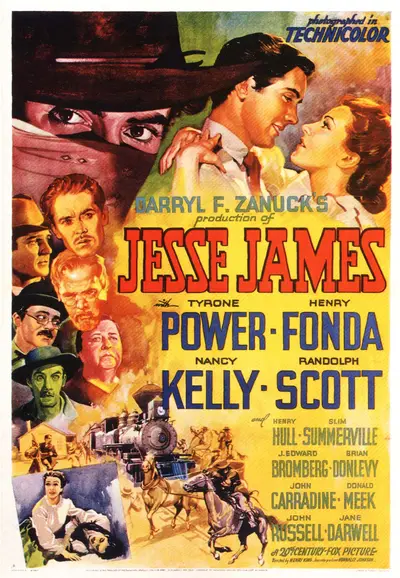
James has been portrayed many times, from Henry King's Jesse James (1939), with Tyrone Power, to Fighting Man of the Plains (1950) and A Time for Dying (1969). In the 1950s films began to show him as a troubled man rather than a social rebel.
Key facts
- Born: 5 September 1847, Clay County (near Kearney), Missouri, US
- Died: 3 April 1882, St. Joseph, Missouri
- Killed by: Robert Ford, a member of his gang
- Gang: James–Younger Gang, with his brother Frank and the Younger brothers
- Civil War: guerrilla with Quantrill's and Bloody Bill Anderson's bushwhackers
- Born 5 September 1847, Kearney, Missouri; died 3 April 1882, St. Joseph, Missouri (Wikidata, Wikipedia)
- Rode with William Quantrill's and 'Bloody Bill' Anderson's bushwhackers (Wikipedia)
- Killed by gang member Robert Ford (Britannica summary)
See also
Television 1
- 1993Walker, Texas Ranger main cast
Questions and answers
Who killed Jesse James, and why?
Robert (Bob) Ford, with his brother Charley there. In 1881 Governor Thomas Crittenden offered rewards for the arrest of Jesse and Frank James. The Fords struck a deal with the authorities for the reward and a pardon, and Bob shot Jesse in the back of the head at home.
Sources: Jesse James, State Historical Society of Missouri – Historic Missourians (accessed 27 October 2026) · Jesse James: Topics in Chronicling America (research guide), Library of Congress (accessed 27 October 2026) · The Death of Jesse James, PBS American Experience (accessed 27 October 2026)
Was Jesse James really shot while dusting a picture?
Legend It's the famous story, but it can't be independently checked. It comes from the Ford brothers' own account, printed in the newspapers of April 1882: Jesse had taken off his gun belt and stood on a chair by a picture when Bob shot him. Versions differ even on whether he was dusting the picture or straightening it.
Sources: The Strange and Mesmerizing Death of the Outlaw Jesse James, True West Magazine, 20 January 2023 (accessed 27 October 2026) · The Death of Jesse James, PBS American Experience (accessed 27 October 2026)
What happened to Robert Ford?
Bob and Charley Ford were tried for murder and found guilty, but the governor pardoned them. Many people saw shooting a man with his back turned as cowardly, and someone scrawled "Coward" beside Bob's signature in a register. Bob later moved to Colorado, where he was shot dead in his own saloon on 8 June 1892.
Sources: Jesse James, State Historical Society of Missouri – Historic Missourians (accessed 27 October 2026) · Jesse James: Topics in Chronicling America (research guide), Library of Congress (accessed 27 October 2026) · The Strange and Mesmerizing Death of the Outlaw Jesse James, True West Magazine, 20 January 2023 (accessed 27 October 2026)
Is Jesse James really buried in his grave?
Very probably. Remains were exhumed from Mount Olivet Cemetery in Kearney, Missouri, in July 1995. A study published in 2001 found that DNA from the teeth and hair matched living relatives on his mother's side, and the scientists said this supports the identification, although this kind of test can't give absolute proof.
Sources: Mitochondrial DNA analysis of the presumptive remains of Jesse James (J Forensic Sci 2001;46(1):173-6), Journal of Forensic Sciences / PubMed (accessed 27 October 2026) · The Strange and Mesmerizing Death of the Outlaw Jesse James, True West Magazine, 20 January 2023 (accessed 27 October 2026)
Was Jesse James a Robin Hood figure?
No. The Robin Hood picture owed a lot to John Newman Edwards of the Kansas City Times, who published Jesse's letters and praised him in editorials. Jesse had fought as a Confederate guerrilla in the Civil War, and his gang robbed and shot people across several states. At Gallatin, Missouri, in 1869, Jesse shot the bank's cashier, whom he thought had killed his old guerrilla leader.
Sources: Jesse James, State Historical Society of Missouri – Historic Missourians (accessed 27 October 2026) · Jesse James: Topics in Chronicling America (research guide), Library of Congress (accessed 27 October 2026)
Gallery 8


In the films 2


Sources
- Jesse James - Wikipedia en.wikipedia.org
- Wikidata: Q213626 wikidata.org
- Jesse James American outlaw - Britannica britannica.com
- Wikimedia Commons: Jesse James NYPost.jpg commons.wikimedia.org
- Jesse James - Historic Missourians, State Historical Society of Missouri historicmissourians.shsmo.org
- The Border Outlaws (J. W. Buel), chapter on guerrilla life archive.org
- The Story of the Outlaw (Emerson Hough), ch. "Guerrilla Warfare—Butcher Quantrell; the James Brothers" gutenberg.org