
California missions (1769)
The California missions were a chain of 21 Spanish Catholic missions founded between 1769 and 1823 along the coast of Alta California, from San Diego in the south to Sonoma north of San Francisco Bay. Run by Franciscan friars, beginning with Junípero Serra, they aimed to bring the Native peoples of California into the Church and into Spanish colonial life. They introduced cattle, horses, wheat, grapes and olives, and became the root of California's ranching, wine and town life. They also brought epidemic disease and a tightly controlled way of life to the Native peoples who joined them. Today the restored missions are among California's oldest buildings and best-loved landmarks.
Founding
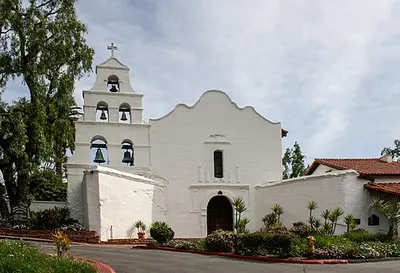
In 1769 Spain sent soldiers and friars north from Baja California under Gaspar de Portolá to hold the coast against Russian and British rivals. With them went the Franciscan Junípero Serra, a Mallorcan scholar who had given up a university career to be a missionary. On 16 July 1769 he founded Mission San Diego de Alcalá. Serra founded nine missions before his death in 1784, and his successor Fermín Francisco de Lasuén founded nine more. The last, San Francisco Solano at Sonoma, followed in 1823. The missions stood about a day's ride apart, linked by the road known as El Camino Real.
Life at the missions
Each mission was a farming community built around a church. Native converts, called neophytes, lived in or near the mission, worked its fields, herds, orchards and workshops, and attended Mass and religious instruction under the friars. At its height in the 1820s the system had over 20,000 Native residents. Mission herds ran into hundreds of thousands of cattle, sheep and horses, and Native mission vaqueros became some of the finest horsemen in the West (see Vaquero). The friars learned Native languages, kept careful registers, and in some places protected Native people from soldiers and settlers.
Serra repeatedly clashed with military commanders over soldiers' abuse of Native women and people. In 1773 he travelled to Mexico City and won from the viceroy a set of regulations, the Representación, that gave the missions more control over Native affairs and limited soldiers' power. In 1775 Kumeyaay warriors attacked and burned Mission San Diego and killed Father Luís Jayme. Serra asked the authorities to spare the attackers' lives and pardon them, and the mission was rebuilt.
Hardship and death
Once baptised, neophytes were not free to leave the mission without permission. Those who broke the mission's rules, including runaways, were punished, and whipping was among the punishments used. Some European visitors were troubled by what they saw: the French navigator La Pérouse, who visited Carmel in 1786, praised the friars' sincerity but compared the regime to a plantation in the West Indies.
Disease was far deadlier than punishment. Measles, smallpox, dysentery and other illnesses spread quickly in the crowded mission villages, where many people lived close together for the first time. By the end of 1832 the mission registers recorded 87,787 baptisms and 63,789 deaths, with especially high death rates among children. Historians agree that the mission years were a time of catastrophic decline for California's Native peoples, though accounts differ on how much of the loss was due to the missions themselves and how much to disease that would have spread anyway.
Not all Native people accepted mission rule. In 1824 the Chumash rose at Santa Inés, La Purísima and Santa Barbara missions. At La Purísima they allowed the soldiers and their families to leave unharmed, and held the mission for a month before troops retook it.
Secularisation
After Mexican independence in 1821, many Mexican leaders saw the missions as relics of Spanish rule. Governor José María de Echeandía began freeing neophytes in 1826, and on 17 August 1833 the Mexican Congress passed an act to secularise the missions. Between 1834 and 1836 they were taken from the friars. The law promised the mission Indians a share of the land, but little of it reached them in practice. Most passed to Californio rancheros and newcomers, and many former neophytes became labourers on the ranchos or drifted to the towns. The mission buildings fell into ruin.
After California joined the United States, the Catholic Church won back the mission churches. Abraham Lincoln signed the documents returning several of them in the 1860s. In the late 19th century, Helen Hunt Jackson's novel Ramona (1884) and the work of Charles Fletcher Lummis and the Landmarks Club stirred a revival of interest. The missions were restored, and the "Mission Revival" style spread across the West.
Mission San Juan Capistrano
Mission San Juan Capistrano, between San Diego and Los Angeles, was first founded on 30 October 1775. The friars soon fled south after the attack on San Diego, and Serra refounded it on 1 November 1776 among the Acjachemen people. The Serra Chapel, built in 1782, is often called the oldest building still in use in California, and the mission's winery produced the first wine in Alta California in 1783. Work on the Great Stone Church began in 1797. On 8 December 1812, during Mass, an earthquake brought the bell tower down on the congregation and some 40 people were killed. The ruins still stand.
The mission declined after secularisation, and a smallpox epidemic in 1862 nearly wiped out the remaining Native community. Lincoln signed the proclamation of 18 March 1865 returning it to the Church. From 1910 Father John O'Sullivan, who had come to Capistrano to recover his health, devoted the rest of his life to restoring it. The silent-film star Mary Pickford was married there in 1911.
Legend and history
- The swallows. The cliff swallows' return to Capistrano each year around St Joseph's Day, 19 March, is a cherished tradition. It is an old observance, but the birds do not keep to the calendar, and in recent years few have nested at the mission.
- The mission myth. In the early 20th century, novels, plays and postcards painted the missions as places of peace and contented Indians. More recently many writers, and many Native Californians, have described them as places of forced labour and death. The evidence includes friars' real devotion and Native suffering, and both should be remembered.
- Saint Junípero Serra. Pope Francis canonised Serra on 23 September 2015. To many Catholics he is a saint who gave his life for the people he served. Many Native Californians objected to the canonisation; accounts differ sharply on his legacy.
Key facts
- Number: 21 missions, plus outlying chapels (asistencias)
- Founded: 1769 (San Diego de Alcalá) to 1823 (San Francisco Solano, Sonoma)
- Order: Franciscans (OFM)
- Founder of the chain: Junípero Serra (born 24 November 1713, Petra, Mallorca; died 28 August 1784, Carmel; canonised 2015)
- Secularised: 1834–36
- Route: El Camino Real, San Diego to Sonoma
- Twenty-one Franciscan missions were founded along the coast of Alta California between 1769 (San Diego de Alcalá, by Junípero Serra) and 1823 (San Francisco Solano, Sonoma) (Palou, 1787; NPS; Wikipedia).
- They brought cattle, horses, wheat, grapes and olives, and Native mission vaqueros became skilled horsemen (NPS; California OHP/NPS Mission System context, 2023).
- Neophytes could not leave a mission without the friars' permission and were punished, including by whipping, for breaking its rules; La Pérouse, visiting Carmel in 1786, praised the friars' sincerity but compared the regime to a West Indian plantation (La Pérouse, 1799; California OHP/NPS Mission System context; Bancroft, vol. III, 1885).
- Introduced diseases such as measles and smallpox caused very high death rates in the crowded missions, especially among children (Bancroft, vol. III, 1885; R. H. Jackson, 1987; California OHP/NPS Mission System context; NPS).
- Mexico's secularisation law of 17 August 1833 was carried out in 1834–36; it promised the mission Indians a share of the land, but most mission land passed into private ranchos held by Californio rancheros and newcomers (Bancroft, vol. IV, 1886, pp. 370–71; Library of Congress; California OHP/NPS Mission System context; Monterey County Historical Society).
- After California joined the United States the mission churches were returned to the Catholic Church, several by patents signed by Abraham Lincoln in the 1860s (Wikipedia).
See also
Gallery 1

Sources
- J.-F. de La Pérouse, A Voyage Round the World, vol. 2 (London: J. Johnson, 1799), pp. c.209–14 (Monterey and Carmel missions, 1786) archive.org
- Francisco Palóu, Life of Ven. Padre Junípero Serra (1787; tr. J. Adam, 1884) archive.org
- H. H. Bancroft, History of California, vol. III, 1825–1840 (Works vol. XX, San Francisco, 1885) archive.org
- H. H. Bancroft, History of California, vol. IV, 1840–1845 (Works vol. XXI, San Francisco, 1886), ch. XV, pp. 370–71 archive.org
- California Office of Historic Preservation / NPS, 'Native Americans and the California Mission System' (Multiple Property Documentation Form) ohp.parks.ca.gov
- Robert H. Jackson, demographic patterns in the California missions (eScholarship, University of California) escholarship.org
- Impact of Spanish Colonization – National Park Service nps.gov
- 'Mexican California', Library of Congress, California as I Saw It collection essay loc.gov
- 'Secularization and the Ranchos, 1826–1846', Monterey County Historical Society mchsmuseum.com
- Spanish missions in California - Wikipedia en.wikipedia.org
- Mission San Juan Capistrano - Wikipedia en.wikipedia.org
- California State Parks, "California's Historic Mission Trail" parks.ca.gov
- Digital Public Library of America, "Spanish Missions in California" dp.la
- R. H. Jackson, "Disease and Demographic Patterns at Santa Cruz Mission", J. of California and Great Basin Anthropology 5 (1983) escholarship.org
- Wikidata: Q1824509 wikidata.org
- Wikimedia Commons: 2007 Mission San Fernando.jpg commons.wikimedia.org
- Wikimedia Commons: Mission San Diego de Alcal%C3%A1 - church.jpg commons.wikimedia.org
