
Tucson, Arizona
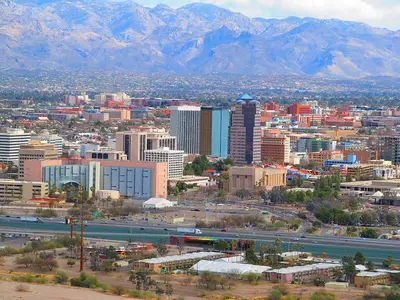
Tucson is the county seat of Pima County and the second-largest city in Arizona, about 60 miles north of the Mexican border. It began as a Spanish fort in 1775, passed to Mexico and then to the United States, and in the frontier years was the biggest town in Arizona Territory and a stop for stagecoaches, soldiers and outlaws alike. Today it is a city of more than half a million people, nicknamed "the Old Pueblo", and home to the University of Arizona and the Old Tucson film studio, where many Western films were shot.
Spanish and Mexican Tucson
People farmed along the Santa Cruz River here for thousands of years before Europeans arrived, and the name comes from an O'odham word for the place. The Jesuit missionary Eusebio Kino founded the mission of San Xavier del Bac a few miles upstream in 1700. On 20 August 1775 Hugo O'Conor, an Irish-born officer in Spanish service, authorised a fort on the river, the Presidio San Agustín del Tucsón, and the town grew up around it. Its soldiers often had to fight off Apache raids. After Mexico won independence in 1821 Tucsón became part of the Mexican state of Sonora.
Becoming American
During the Mexican–American War, Philip St George Cooke and the Mormon Battalion passed through Tucsón in 1846, and the wagon road they opened became one of the main routes to California in the gold rush of 1849 (see Southern Emigrant Trail). The town itself stayed Mexican until the Gadsden Purchase, signed in 1854, moved the border south; American troops took formal control in 1856.
Tucson became a stage station on the San Antonio–San Diego mail line in 1857 and a divisional headquarters of the Butterfield Overland Mail in 1858. In 1861 conventions in the region voted to join the Confederacy, but Union troops from California took the town in May 1862 after the fight at Picacho Pass. Tucson was capital of Arizona Territory from 1867 to 1877, was incorporated in 1877, and was linked to the outside world by rail on 20 March 1880. The mayor marked the day by sending telegrams to, among others, the President and the Pope, announcing that the "ancient and honorable pueblo" was now joined to the railway; this is the most likely origin of "the Old Pueblo".
Outlaws, stagecoaches and the Earp vendetta
Tucson saw its share of frontier violence. In 1877 and 1878 the masked road agent William Brazelton robbed stagecoaches near the town, until Pima County Sheriff Charles Shibell and a citizen posse killed him in August 1878.
The town's best-known moment came in March 1882, after the murder of Morgan Earp in Tombstone. Wyatt Earp escorted his wounded brother Virgil and his family to the railway on their way to California. At the Tucson station they found Frank Stilwell, one of the suspects in Morgan's killing, apparently lying in wait, and Wyatt's party killed him beside the tracks. It was the first killing of Wyatt's "vendetta ride" against the Cochise County Cowboys. For the background, see Gunfight at the O.K. Corral.
Old Tucson and the movies
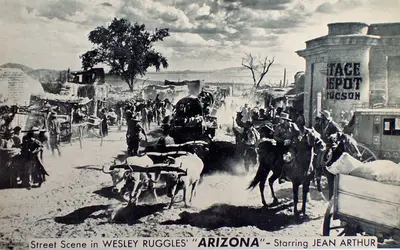
West of the city stands Old Tucson, built as a set for the 1940 film Arizona (1940) and later run as a film studio and Western theme park. Many Westerns were shot there, including Rio Bravo (1959), El Dorado (1966) and Rio Lobo (1970), and Tombstone (1993) was also filmed in and around Tucson.
Every February the city holds the Fiesta de los Vaqueros, its rodeo week, which marks the start of the American rodeo season and includes what is billed as the world's largest parade without motor vehicles.
See also
Nearby
- Contention City, Arizona 85 km
- Fort Huachuca 92 km
- Tombstone, Arizona 99 km
- Bird Cage Theatre 99 km
- Fort Bowie 141 km
- Fort Apache, Arizona 195 km
Key facts
- Founded/established: 1775 (Wikidata P571)
- Country: United States (Wikidata P17)
- Located in: Pima County (Wikidata P131)
- Instance of: big city, city in the United States, county seat (Wikidata P31)
Gallery 1

Appears in 1

Sources
- Tucson, Arizona - Wikipedia en.wikipedia.org
- Wikidata: Q18575 wikidata.org
- Wikimedia Commons: CatalinasAndTucsonAZ.jpg commons.wikimedia.org
- Wikimedia Commons: View of Tucson from Sentinel Peak 2.jpg commons.wikimedia.org
