
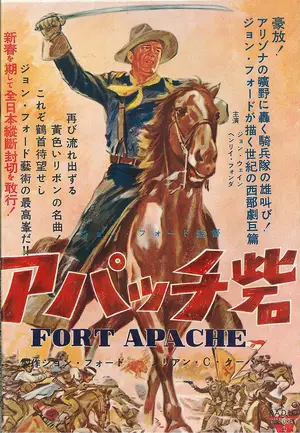

True Grit Rating: Fort Apache
Loading the ticket…
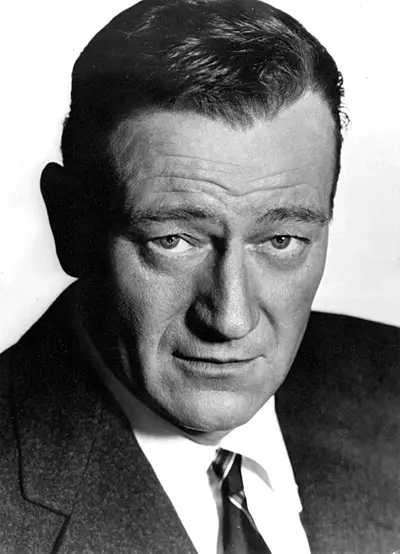
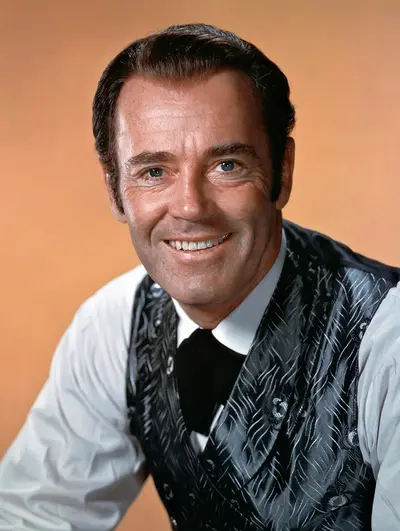
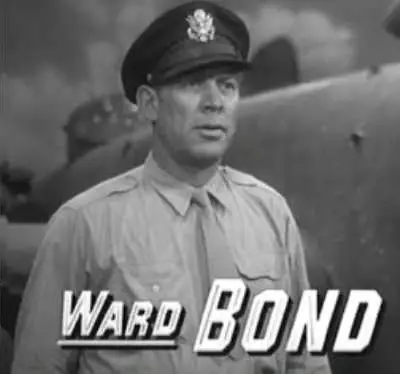
Fort Apache is a 1948 American Western directed by John Ford and starring John Wayne and Henry Fonda, with Shirley Temple, Pedro Armendáriz and Ward Bond. It was the first film in Ford's "Cavalry Trilogy", followed by She Wore a Yellow Ribbon (1949) and Rio Grande (1950). The screenplay was inspired by James Warner Bellah's 1947 short story "Massacre". It is widely considered the best of the trilogy, and it was one of the first Hollywood films to portray Native Americans with sympathy.
Plot
A stagecoach crosses the south-western desert carrying Lieutenant Colonel Owen Thursday (Fonda), a widower, and his teenage daughter Philadelphia (Temple) to his new command at Fort Apache, an isolated cavalry post on the Arizona frontier. Thursday is a West Point graduate who was brevetted a general in the Civil War. He resents being sent to what he sees as a career-ending posting, and he knows little about the country.
At the fort he clashes with his experienced second-in-command, Captain Kirby York (Wayne), who understands the Apache and the realities of frontier soldiering. Philadelphia, meanwhile, falls for a young lieutenant, Michael O'Rourke, the son of the regiment's sergeant major. The Apache, driven to rebellion partly by a corrupt government agent, are led by Cochise. York arranges a parley in good faith. Thursday's pride, ambition and contempt for his enemy then lead the regiment towards disaster.
Production
Frank S. Nugent wrote the screenplay, and Ford and Merian C. Cooper produced for RKO. The historical sources for Bellah's story have been linked both to George Armstrong Custer's defeat at the Little Bighorn and to the Fetterman Fight, and Thursday also closely resembles Lieutenant Howard B. Cushing. Thursday is also often said to be modelled on Custer.
Some exteriors were shot in Monument Valley, Utah. Scenes of the fort itself and of the Apache agent's trading post were filmed at the Corriganville Movie Ranch in the Simi Hills of Southern California. The film was shot in black and white.
Reception
Bosley Crowther of The New York Times praised the film in June 1948 for its action and for a "new and maturing viewpoint" on the Indian wars, in which the villain is not the "heathen Indian" but "a hard-bitten Army colonel, blind through ignorance and a passion for revenge". The film made a profit of $445,000. It won Best Director and Best Cinematography at the Locarno International Film Festival, and Nugent was nominated for a Writers Guild of America award. It has been seen as Fonda's film despite Wayne's star power.
In 2012 the New York Times critic Dave Kehr called it "one of the great achievements of classical American cinema" and "among the first 'pro-Indian' Westerns".
History and myth
The historian Dee Brown praised its re-creation of life on a cavalry post as "grounded in reality", noting how closely it resembles surviving photographs of the period. He called the last quarter of the film "bad mythology", however, and said it was not a true portrayal of the Apache wars. The film's ending looks at how a disaster can be turned into a heroic legend, a theme Ford returned to in The Man Who Shot Liberty Valance. The same theme runs through this wiki's pages on the Gunfight at the O.K. Corral and Wild Bill Hickok.
Disputed points
- The real model for Thursday: accounts differ: some say he was modelled on Custer, while others link Bellah's story to both the Little Bighorn and the Fetterman Fight and compare Thursday to Howard B. Cushing.
Key facts
- Released: 1948 (reviewed by The New York Times on 25 June 1948)
- Director: John Ford
- Producers: Merian C. Cooper and John Ford
- Screenplay: Frank S. Nugent, inspired by James Warner Bellah's "Massacre" (1947)
- Music: Richard Hageman
- Studio: RKO Radio Pictures
- Running time: 125 minutes
- Filmed in: Monument Valley, Utah; Corriganville Movie Ranch, California
- Awards: Best Director and Best Cinematography, Locarno International Film Festival
- Series: first film of Ford's Cavalry Trilogy
- Directed by John Ford
- Released 1948
- Followed by She Wore a Yellow Ribbon (1949) and Rio Grande (1950)
- Inspired by James Warner Bellah's 1947 short story "Massacre"
Cast



See also
If you liked this
Picked from this wiki's own links: same film series, same director, same lead actor.

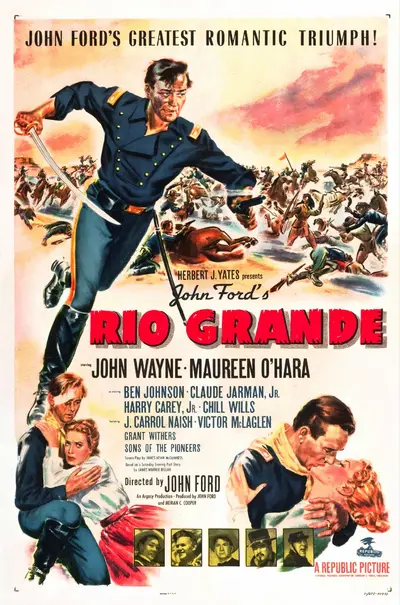 Rio Grande1950Same series


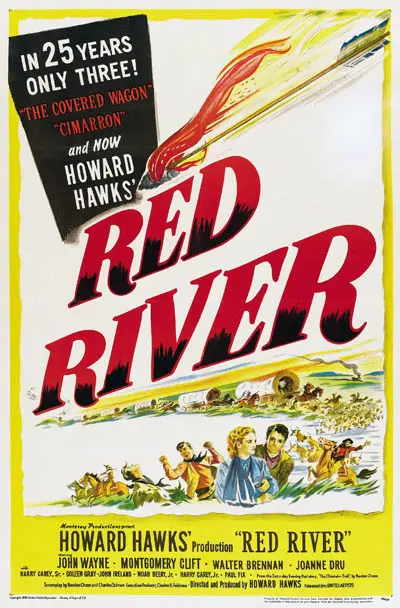 Red River1948Also starring John Wayne


Guns on screen
- Winchester Model 1866 "Yellow Boy" used by Captain Kirby York (John Wayne) York carries one at one point. (single source) Sources: Fort Apache – Internet Movie Firearms Database (accessed 26 October 2026)
- Springfield Model 1873 cavalry carbine used by U.S. cavalry troopers The standard long arm of the cavalry in the film. (single source) Sources: Fort Apache – Internet Movie Firearms Database (accessed 26 October 2026)
- Colt Single Action Army used by U.S. cavalry troopers The few sidearms drawn by the troopers are Colt single-actions. (single source) Sources: Fort Apache – Internet Movie Firearms Database (accessed 26 October 2026)
- Winchester Model 1892 rifles and saddle-ring carbines used by Apache warriors Anachronistic for the story's period; some of the screen carbines are described as Model 1876 musket carbines altered to look like 1892s. (single source) Sources: Fort Apache – Internet Movie Firearms Database (accessed 26 October 2026)
Filming locations
- Monument Valley · Monument Valley (Arizona side), Arizona–Utah border, United States · map · Wikidata · Exteriors; later accounts say the unit worked on the Arizona side of the valley. · Sources: Fort Apache – AFI Catalog (accessed 26 October 2026) · Movies Filmed in Grand County and San Juan County – Moab to Monument Valley Film Commission (PDF) (accessed 26 October 2026)
- Goulding's Trading Post · Monument Valley, San Juan County, Utah, United States · map · Wikidata · Listed by the regional film commission among this film's sites. · Sources: Movies Filmed in Grand County and San Juan County – Moab to Monument Valley Film Commission (PDF) (accessed 26 October 2026)
- Mexican Hat · San Juan County, Utah, United States · map · Wikidata · Listed by the regional film commission among this film's sites. · Sources: Movies Filmed in Grand County and San Juan County – Moab to Monument Valley Film Commission (PDF) (accessed 26 October 2026)
Frontier folk
This film is listed on: Cavalry troopers and frontier scouts · Corrupt lawmen and officials · Apache (all Frontier folk)
True Grit RatingWhat's this?Woke: None foundSVLIMDb ★7.4Partly checked
True Grit score: 99/100, Gold Partly checked
How the score is worked out:
- Start100
- Diamond needs all five checks; not met (raw score under 109): 100 → 99
- Presumed (Hays Code, 1934–1967): sex & nudity, violence, language presumed no, counted as checked0
- True Grit score99 · Gold
Classic Western checks
0 of 5 yes · Classic Western
- Called “revisionist”NoCritics count it as the first film of Ford's cavalry trilogy; the borderline revisionist reading gives way to the classic one, and its colonel is fictional.[1]
- Settlers or cavalry as villainsNoThe antagonists are Lt. [2]
more
The antagonists are Lt. Col. Thursday and the corrupt agent Meacham; one critic called it "among the first 'pro-Indian' Westerns", portraying indigenous Americans with "sympathy and respect"; Cochise's people have fled starvation and abuse. - Faith shown negativelyNoThe plot shows no clergy or faith portrayed negatively.[2]
- History rewrittenNoFiction inspired by real events: Colonel Thursday and the film's battle are invented, loosely drawn on Custer's defeat at the Little Bighorn; it does not … [3]
more
Fiction inspired by real events: Colonel Thursday and the film's battle are invented, loosely drawn on Custer's defeat at the Little Bighorn; it does not present itself as that battle. - A people shown as villainsNoNo: the plot source pins the villainy on named individuals or a specific band, not on a people as a whole.[1]
Woke content (modern messaging)
None found0 of 8 items found so far
Show all 8 (2 not found · 6 not known)
Unless noted: Unknown.
- Characters recast for representationNot known
- Gender roles reversed or critiquedNot known
- Present-day political languageNot known
- Allegory for current politicsNot foundReleased in 1948, before the 21st-century debates this item covers, so it cannot be an allegory of them.[2]
- Western civilisation framed as inherently guiltyNot known
- Environmental activismNot foundNo: no source raises an environmental message (5 Nov 2026).[2]
- Source material changed for messagingNot known
- LGBT or gender-identity themesNot known
Content guide
- SSex & nudityPresumed no
- VViolencePresumed no
- LLanguagePresumed no
Presumed no (Hays Code)
NoneMildModerateStrongNot known
Audience
★ 7.4/10 from viewers on IMDb (22k votes)No deduction (5.0 and up).
Sources
Information courtesy of IMDb (https://www.imdb.com). IMDb rating as of 13 October 2026.
Checked 17 October 2026 · Reviewed by Frontier Editor
Partly checked: 1 check not known. Not known items are left out of the score.
Member reviews
What members think. Member reviews never change the True Grit score. The True Grit score is worked out by the editors from sources.
Sources
- Fort Apache (film) - Wikipedia en.wikipedia.org
- Wikidata: Q773276 wikidata.org
- Wikimedia Commons: Eiganotomo-fortapache-nov1952.jpg commons.wikimedia.org
- Fort Apache - Britannica britannica.com
- IMDb Non-Commercial Datasets developer.imdb.com
- Fort apache q29sbgvjdglvbjpwwc0zmjqymtc - bbfc.co.uk bbfc.co.uk
- Rotten Tomatoes (score via Wikidata) rottentomatoes.com