
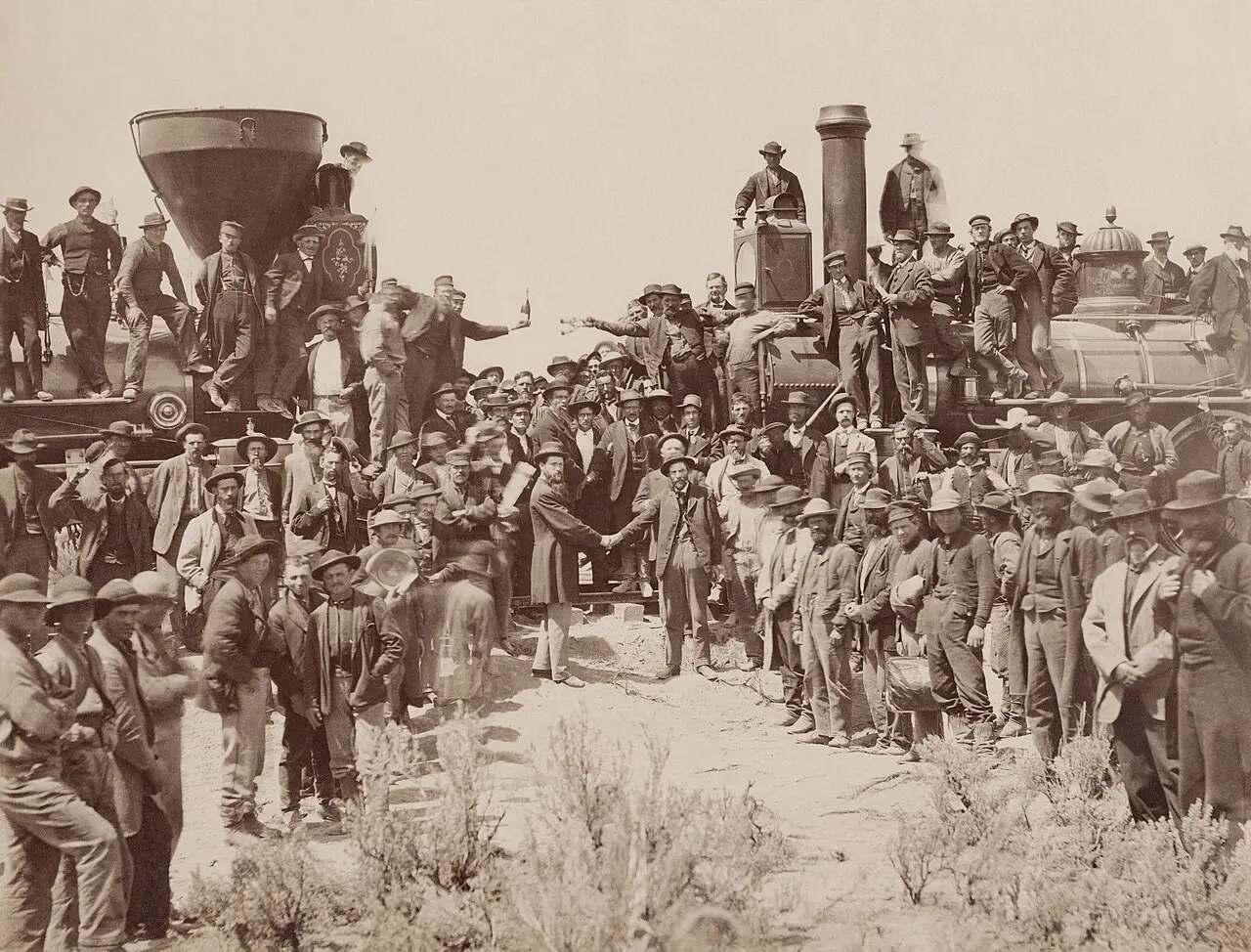

The first transcontinental railroad was a 1,911-mile (3,075 km) line built between 1863 and 1869. It joined the existing eastern rail network at Council Bluffs, Iowa, to the Pacific coast at San Francisco Bay. The Central Pacific built east from Sacramento and the Union Pacific built west from Omaha, and the two met at Promontory Summit, Utah Territory, where Leland Stanford and Thomas Durant struck the last spikes, among them the ceremonial gold "Last Spike", on 10 May 1869. A journey that had taken months by wagon or ship could now be made in a matter of days, at a fraction of the cost, and the railroad transformed the American West.
Background
By the 1850s Americans had settled California and Oregon, but reaching them meant a dangerous overland trek, a long voyage around South America, or a crossing of the Isthmus of Panama. Fast services such as the Pony Express (1860–61) showed how much demand there was for quicker links, but only a railroad could carry people and freight in bulk.
The Pacific Railway Acts
During the Civil War, after the secession of the Southern states removed their opposition in Congress, President Abraham Lincoln signed the Pacific Railway Act of 1862. It and later acts gave the building companies land grants along the route and government bonds for each mile completed. That arrangement encouraged speed, and in places it also encouraged corruption, most notoriously in the Crédit Mobilier scandal that later engulfed the Union Pacific's finances.
Building east: the Central Pacific
The Central Pacific Railroad, led by the "Big Four" (Leland Stanford, Collis Huntington, Mark Hopkins and Charles Crocker), started from Sacramento in 1863. It faced the hardest terrain first: the granite of the Sierra Nevada, where crews blasted tunnels through winter snows. With labour scarce, the company recruited thousands of Chinese workers, who came to make up most of its workforce. They did most of the heavy manual labour, including the blasting of the Sierra tunnels, while nearly all the white workers held better-paid supervisory or skilled jobs. The Central Pacific laid about 690 miles of track.
Building west: the Union Pacific
The Union Pacific began from the Omaha and Council Bluffs area and pushed west across the Great Plains and the Rockies, laying about 1,085 miles. Its workforce included many Irish immigrants and Civil War veterans. Temporary railhead camps, nicknamed "Hell on Wheels", moved with the track and were known for saloons, gambling and violence, foreshadowing the rough frontier towns that grew up along the lines. A third company, the Western Pacific Railroad, completed the link from Sacramento to the Bay.
Promontory Summit
The two lines met at Promontory Summit, Utah Territory, on 10 May 1869. After a ceremonial last spike was tapped into place, a telegraph message announced the completion to the nation. The site is now preserved by the US National Park Service as Golden Spike National Historical Park.
Impact
The railroad brought settlers, goods and markets west, and the railroads sold their granted land to settlers, speeding the settlement of the West. Railheads in Kansas such as Abilene did something similar for cattle, giving long drives such as the Chisholm Trail a place to ship beef east. Hunters were hired to feed the construction crews with meat from the great bison herds, hunted with weapons such as the Sharps rifle, and the line ran through the lands of Native nations such as the Lakota and Cheyenne, and its survey parties were sometimes attacked.
In film
The building of the railroad is a classic Western subject, from John Ford's silent epic The Iron Horse (1924) to Cecil B. DeMille's Union Pacific (1939) and the railroad section of How the West Was Won (1962). Railroad expansion also drives the plot of Once Upon a Time in the West (1968).
Key facts
- Built: 1863–1869
- Length: 1,911 miles (3,075 km)
- Completed: 10 May 1869
- Meeting point: Promontory Summit, Utah Territory
- Builders: Central Pacific Railroad (about 690 miles), Union Pacific Railroad (about 1,085 miles), Western Pacific Railroad Company
- Termini: Council Bluffs, Iowa / Omaha, Nebraska, and Oakland Long Wharf, San Francisco Bay
- Today: Golden Spike National Historical Park
- Built 1863–1869 by three private companies on land granted by the US government
- Central Pacific built 690 miles east from Sacramento
- Union Pacific built 1,085 miles west from Council Bluffs/Omaha
- Opened to through traffic on 10 May 1869 when Leland Stanford tapped the gold "Last Spike"
- The meeting site is now Golden Spike National Historical Park (NPS)
See also
Appears in 1

Sources
- First transcontinental railroad - Wikipedia en.wikipedia.org
- Index - U.S. National Park Service nps.gov
- Index - U.S. National Park Service nps.gov
- Wikidata: Q1753108 wikidata.org
- Wikimedia Commons: East and West Shaking hands at the laying of last rail Union Pacific Railroad - Restoration.jpg commons.wikimedia.org