
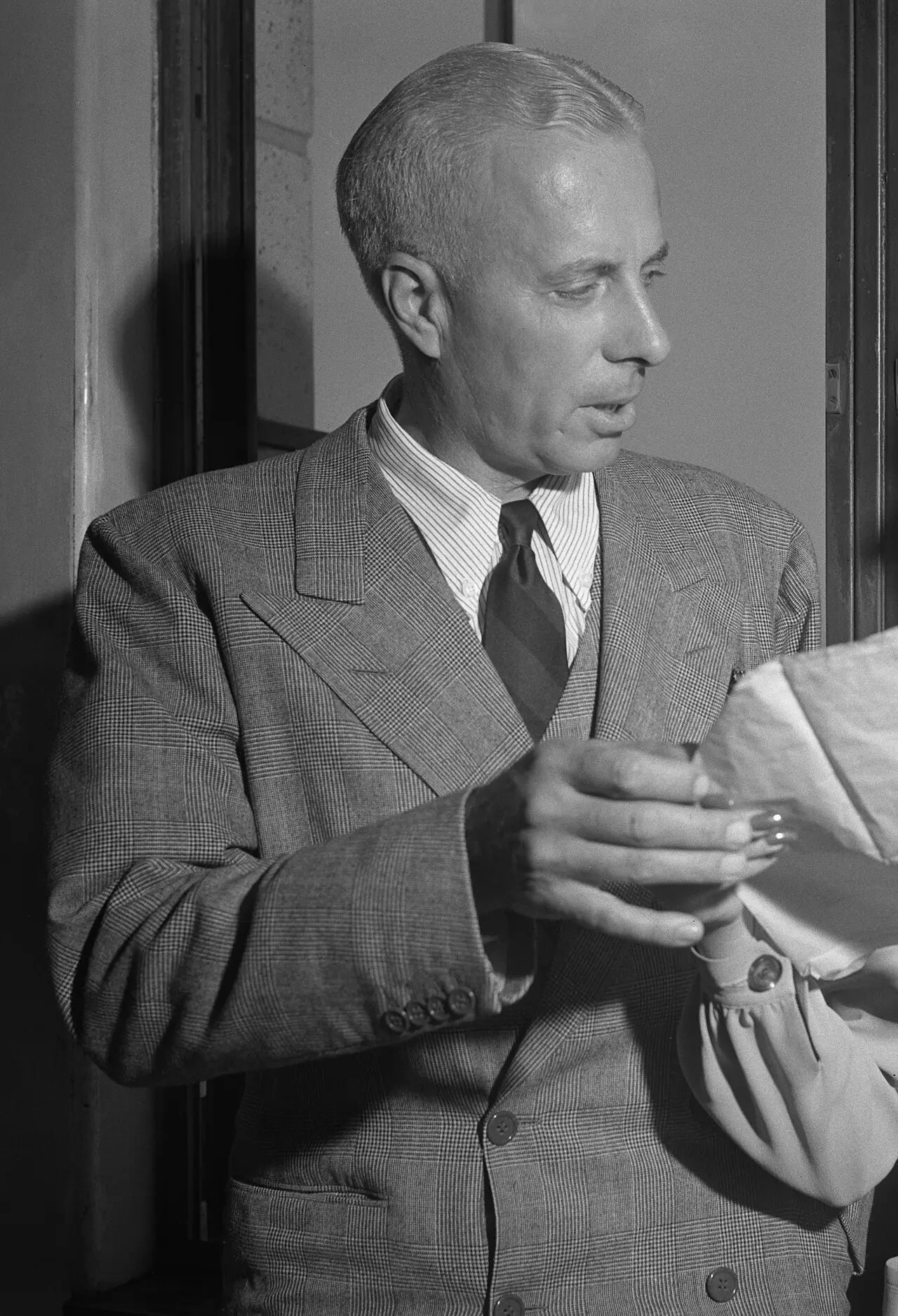

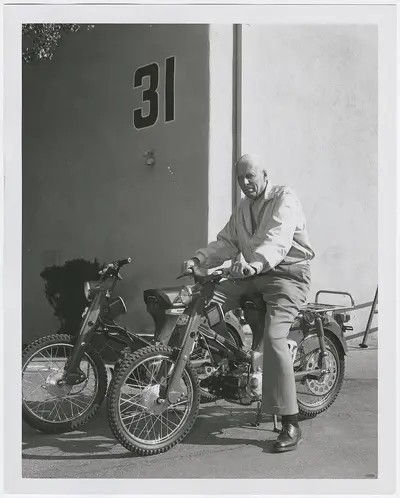
Howard Winchester Hawks (1896–1977) was an American director, producer and screenwriter of the classic Hollywood era. He worked in almost every genre, from screwball comedy and gangster films to science fiction and film noir, but a handful of Westerns, most of them starring John Wayne, sit among his most admired work. The critic Leonard Maltin called him "the greatest American director who is not a household name".
Background
Hawks was born on 30 May 1896 in Goshen, Indiana, the eldest child of a wealthy paper manufacturer, and grew up largely in Pasadena, California. He made his name in the 1930s with films such as Scarface (1932) and Bringing Up Baby (1938). Early on he developed the figure later called the "Hawksian man", a hero defined, in the critic Andrew Sarris's words, by "an instinctive professionalism". His tough, quick-talking heroines became known as the "Hawksian woman".
The Westerns
The Outlaw (1943)
Hawks began The Outlaw, a Billy the Kid story produced by Howard Hughes, but Hughes replaced him and took over as director himself. Hawks is sometimes listed alongside Hughes as a director, but the finished film is usually credited to Hughes.
Red River (1948)
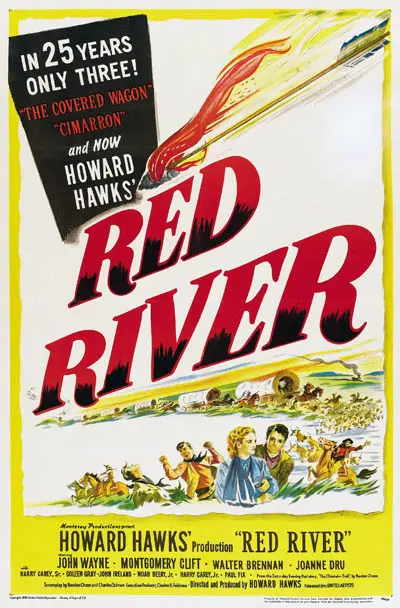
Red River, which Hawks both directed and produced, gives a fictional account of the first cattle drive from Texas to Kansas along the Chisholm Trail. It is an epic Western reminiscent of Mutiny on the Bounty: the drama is a battle of wills between a hard rancher (Wayne) and his adopted son, played by Montgomery Clift in his first film. It is widely considered Hawks's most enduring film. It brought Hawks a Directors Guild of America nomination.
The Big Sky (1952)
The Big Sky, which Hawks produced and directed, is a frontier adventure set in 1832 about fur trappers travelling up the Missouri River. Kirk Douglas stars, and Dudley Nichols wrote the screenplay from A. B. Guthrie Jr.'s novel. It earned Hawks a second Directors Guild nomination.
Rio Bravo (1959)
Rio Bravo stars Wayne as a Texas sheriff who arrests the brother of a powerful rancher for murder and must hold him in jail until a US marshal arrives. His only allies are a drunk (Dean Martin), a young gunfighter (Ricky Nelson) and a lame old man (Walter Brennan). Wayne and Hawks made it partly as a reply to High Noon (1952), whose marshal goes round the town asking for help. Jules Furthman and Leigh Brackett wrote the script, and it was filmed at Old Tucson Studios in Arizona. It brought Hawks a third Directors Guild nomination, and in 2014 it was added to the US National Film Registry. The critic Robin Wood said that if he had to choose one film to justify the existence of Hollywood, it would be Rio Bravo.
El Dorado (1966) and Rio Lobo (1970)
Hawks's last two films were both Westerns starring Wayne and written by Brackett, and both reworked the Rio Bravo situation of a sheriff and a few friends standing off a gang. In El Dorado Wayne plays a gunfighter who helps an old friend, a drunken sheriff (Robert Mitchum), in a fight between ranchers over water. It was first released in Japan in December 1966 and in the United States in June 1967, and it was a commercial success. Rio Lobo (1970), which opens with a Civil War train raid, was Hawks's final film. It disappointed critics and audiences at the time, though later reviews have been kinder. An injury he suffered on its set severely damaged one of his legs.
Style and legacy
Hawks liked to tell a story "as simply as possible, with the camera at eye level". Orson Welles summed up the comparison with John Ford as "Hawks is great prose; Ford is poetry", and Hawks himself said he copied Ford "every time I could". His Westerns are less about landscape and history than about small groups of professionals, their loyalty and their banter. Directors he influenced include Clint Eastwood, John Carpenter and Quentin Tarantino, and the French critics of Cahiers du cinéma championed him as an auteur. He received an honorary Academy Award in 1974. Hawks died at his home in Palm Springs, California, on 26 December 1977, after complications from a fall.
Key facts
- Born: 30 May 1896, Goshen, Indiana, US
- Died: 26 December 1977, Palm Springs, California, US
- Roles: director, producer, screenwriter
- Key Westerns: Red River (1948), The Big Sky (1952), Rio Bravo (1959), El Dorado (1966), Rio Lobo (1970)
- Main Western star: John Wayne
- Honours: honorary Academy Award (1974)
- Occupations (Wikidata): screenwriter, film producer, film director, actor
- Born 1896-05-30
- Died 1977-12-26
See also
Filmography
As director 5
- 1948Red River
- 1952The Big Sky
- 1959Rio Bravo
- 1966El Dorado
- 1970Rio Lobo
Gallery 8



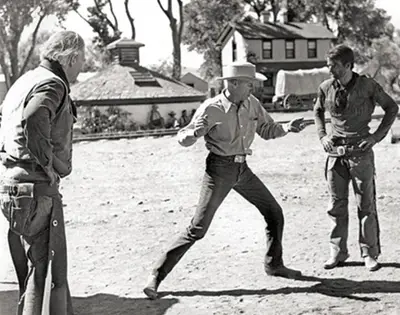

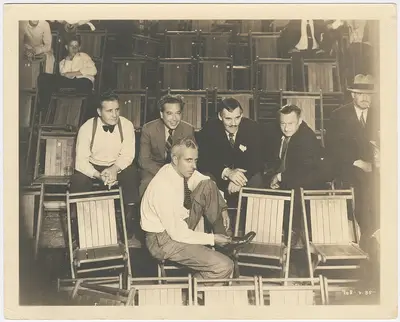

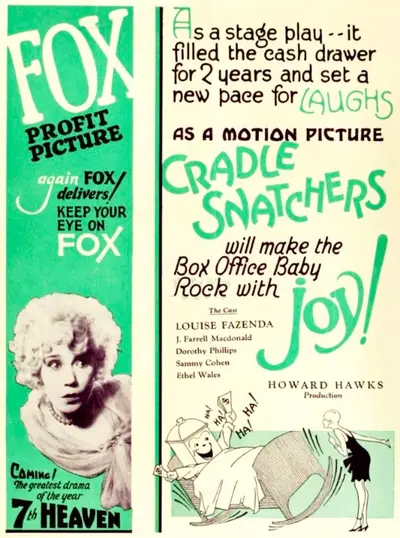



In the films 1

Sources
- Howard Hawks - Wikipedia en.wikipedia.org
- Wikidata: Q51581 wikidata.org
- Wikimedia Commons: Howard Hawks.JPG commons.wikimedia.org
- Red River film 1948 - Britannica britannica.com
- High Noon - Britannica britannica.com