
Ranchers, cattlemen and cowboys
Usually good · Part of Frontier folk
Some statements on this page are still being checked and are marked "Needs further sources".
The cowboy is the hero most people picture when they think of a Western, and the rancher is the man who employs him.
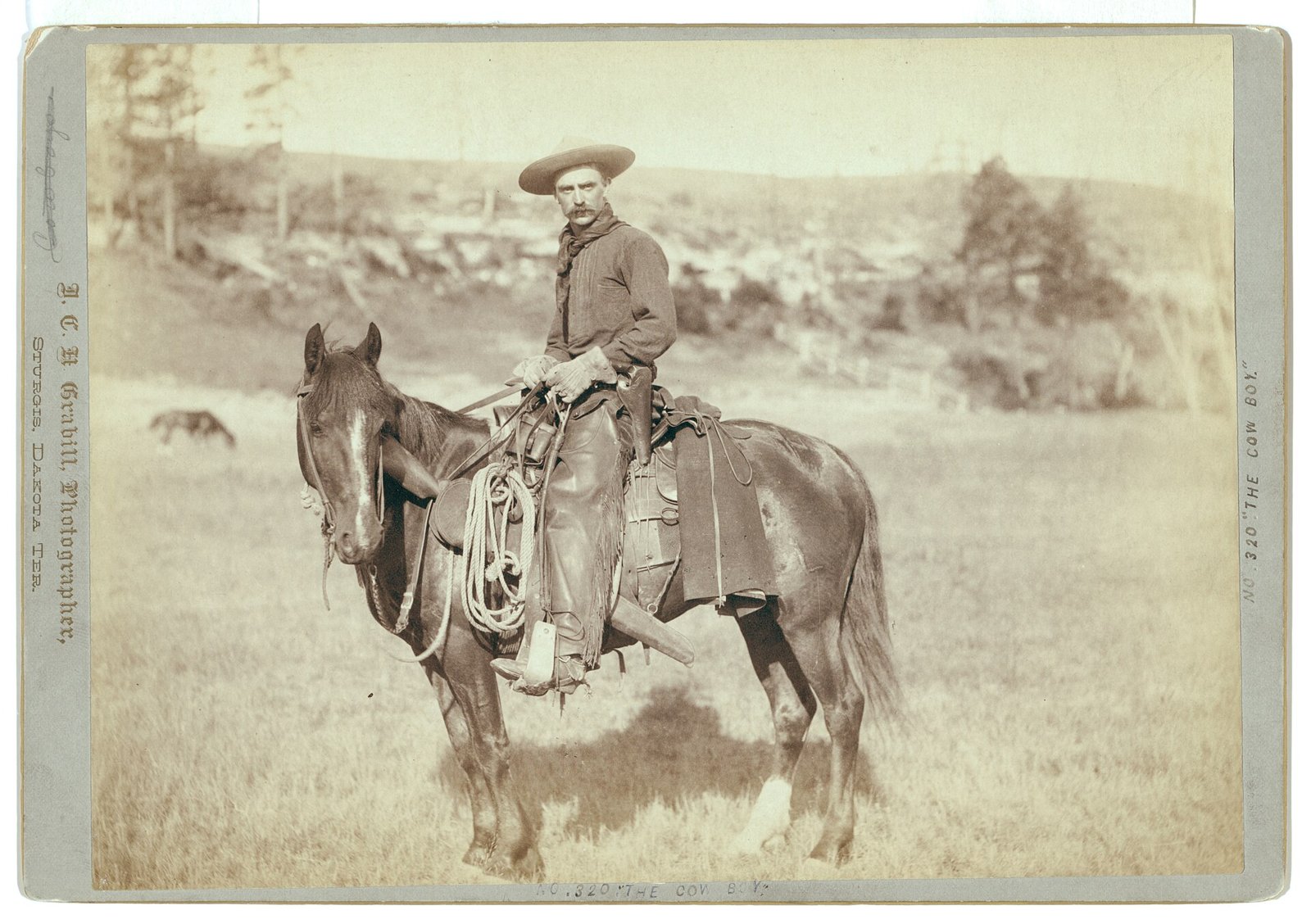
"The Cow Boy": a mounted cowboy, Dakota Territory, about 1888.
Posed photograph · John C. H. Grabill · c.1888 · Source: https://commons.wikimedia.org/wiki/File:Grabill_-_The_Cow_Boy.jpg · Licence: Public domain – UK: photographer John C. H. Grabill died 1903, more than 70 years ago (CDPA 1988 s.12(2))

In classic Westerns
In classic Westerns the cowboy is a skilled, loyal hand who rides for the brand: tough, plain-spoken, courteous to women and quick to stand up to a bully. The honest rancher or cattleman is often the hero too, building a herd from nothing, as in Red River (1948). The trail drive is one of the genre's great set pieces: thousands of longhorns, river crossings, stampedes and the long ride to a railhead in Kansas. (The powerful rancher who bullies his neighbours is a separate type; see Cattle barons, crooked railroad men and bankers.)
- Look: Wide-brimmed hat, bandanna, chaps, spurs, boots, a lariat and a saddle horse; often a Colt revolver and a Winchester.
- Values: Loyalty to the outfit, a code of honour, hard work and keeping one's word.
- Role in the story: Hero, sidekick or the decent working man caught between bigger forces.
Sub-types
Ranchers and cattlemen
Owners of a herd and a ranch, from struggling small ranchers to men who built an outfit from a few head of cattle.
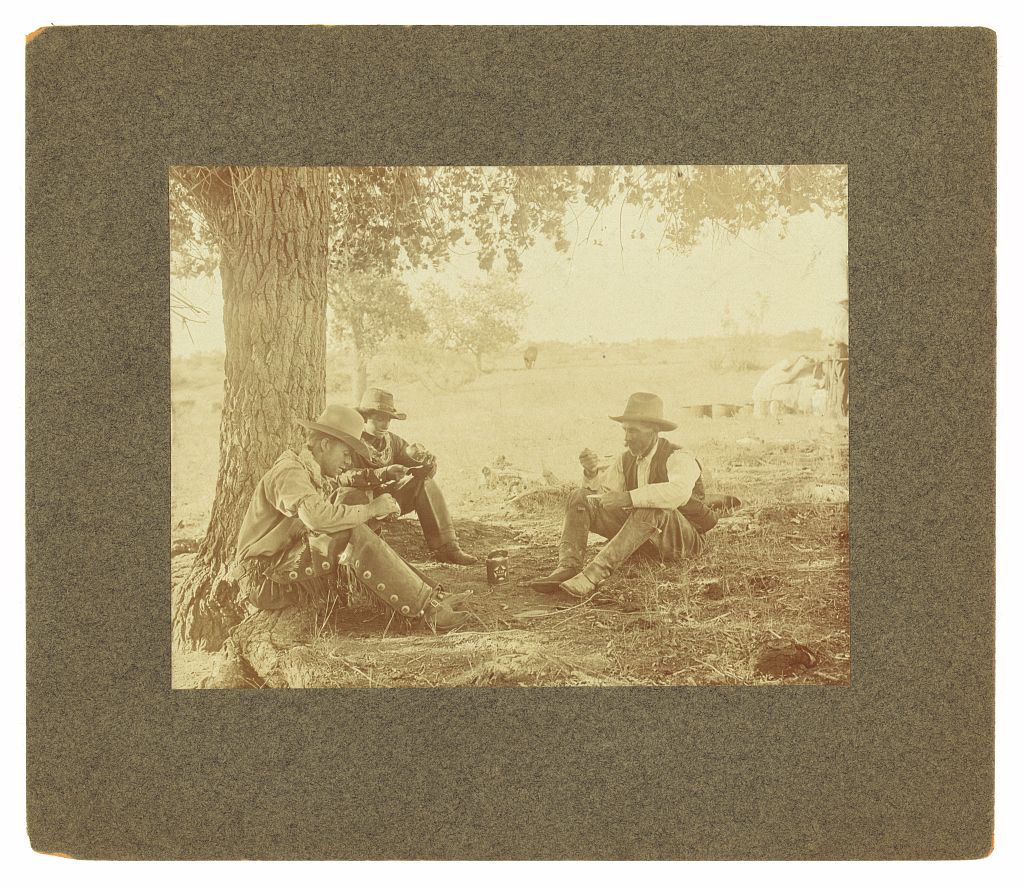
Cowboys eating tomatoes, Texas, 1907: ranch hands of the late open-range years, after the great trail drives.
Photograph (candid) · Erwin E. Smith · 1907 · Source: https://commons.wikimedia.org/wiki/File:Cowboys_eating_tomatoes_-_photo_by_Erwin_E._Smith,_Bonham,_Texas._LCCN2005676953.jpg · Licence: Public domain – UK: photographer Erwin E. Smith died 1947, more than 70 years ago (CDPA 1988 s.12(2))

Trail-drive cowboys
Hands who drive the herd north, with a trail boss, a cook and his chuckwagon, and a remuda of spare horses.
Needs a photo: Working cowboys on a roundup or trail drive, with chuckwagon.
Vaqueros
The Mexican and Californio horsemen whose roping and riding skills the cowboy inherited; in classic films they appear mostly as ranch hands or rivals south of the border.
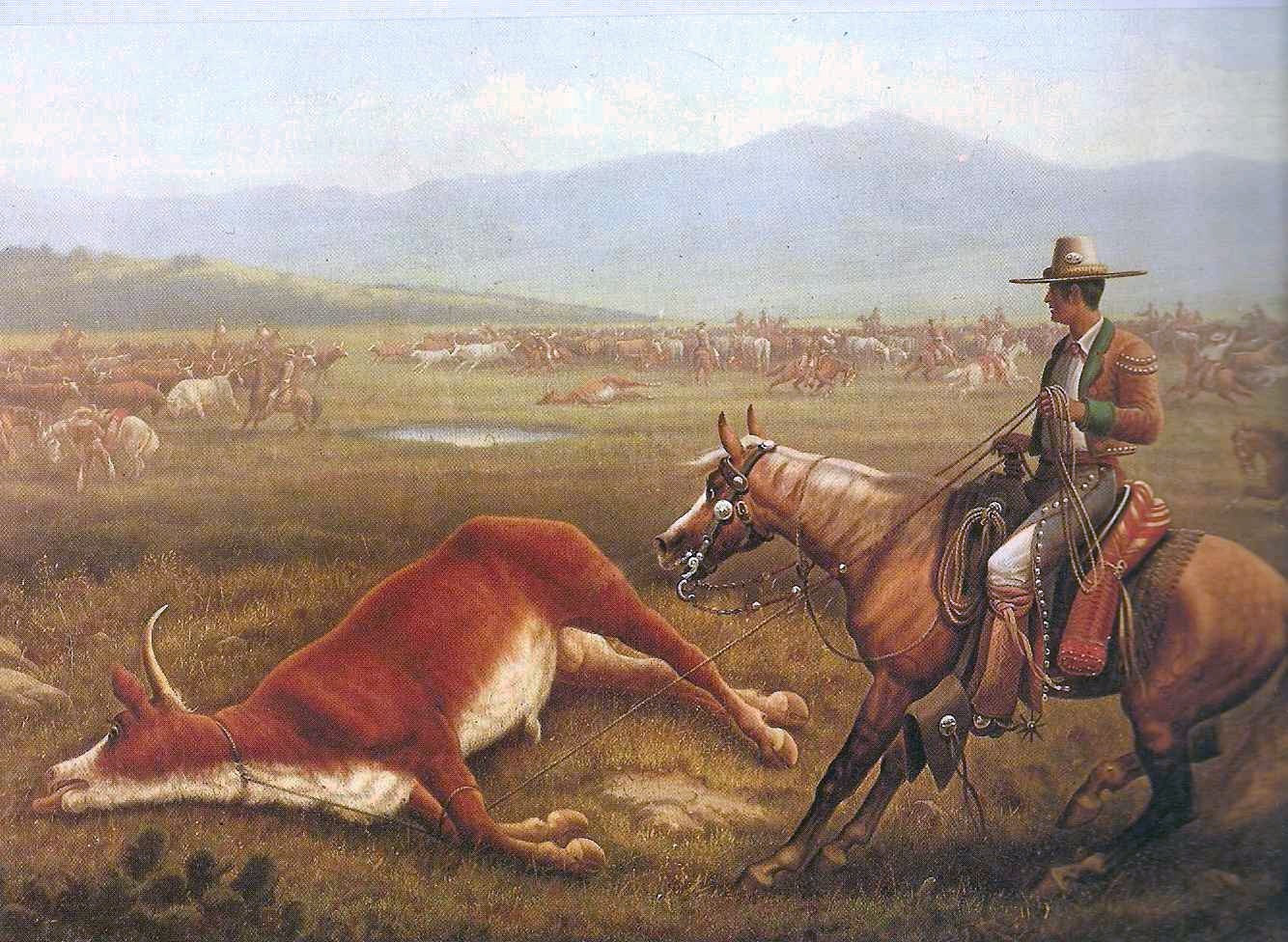
"Vaqueros", a painting of 1877 by James Walker, showing Mexican vaqueros roping cattle in 1830s California. This is a painting, not a photograph.
Art (a painting, not a photograph) · James Walker · 1877 (depicts 1830s Mexican California) · Source: https://commons.wikimedia.org/wiki/File:Vaqueros.jpg · Licence: Public domain – UK: artist James Walker died 1889, more than 70 years ago (CDPA s.12(2)).

In history
Documented history from period sources. The film portrayal is described above under "In classic Westerns"; this section is kept separate.
A cowboy who drove herds north in the 1880s describes the working kit: every man had an oiled-canvas slicker tied behind the saddle, spurs were a matter of taste, only about half the outfit wore leggings (chaps), and no one used a whip on cattle. Chaps were worn for protection in brush or cold, not for show, and were laid aside in hot weather.
The range pistol was a .44 or .45 calibre revolver, worn on a loose belt low on the right hip, and a ranchman carried a rifle as well. A Texas cowboy's memoir of 1885 shows that in South Texas whole crews could be Mexican vaqueros working under an Anglo boss.
How the films differ
Film cowboys wear chaps all the time, carry tied-down twin holsters and crack bullwhips. Period accounts describe one revolver on a loose belt, chaps only when needed, and no cattle whips. Films also mostly leave out the Mexican vaqueros and Black cowboys who worked on Texas crews. (Needs further sources: how many of the cowboys on Texas crews were Black or Mexican is not yet established from period sources; no figure is given here.)
Films
| # | Film | How it qualifies | From the wiki's summary |
|---|---|---|---|
| 1 | 3:10 to Yuma (2007) | Ranchers and cattlemen | A rancher ruined by drought takes a dangerous, well-paid job escorting a notorious outlaw to his trial. |
| 2 | The Man Who Shot Liberty Valance (1962) | Ranchers and cattlemen | A senator returns to a Western town for a funeral and tells a reporter how, as a young lawyer, he once stood up to a vicious outlaw. |
| 3 | Giant (1956) | Ranchers and cattlemen | Giant (1956) is an epic drama directed by George Stevens that follows a Texas ranching family over several decades. |
| 4 | Red River (1948) | Ranchers and cattlemen; Trail-drive cowboys | A fictional account of the first cattle drive up the Chisholm Trail from Texas to Kansas, and the bitter feud it sparks between a hard rancher and his adopted son. |
| 5 | Open Range (2003) | Ranchers and cattlemen; Trail-drive cowboys | Two cattlemen who drive their herds across open range, played by Robert Duvall and Kevin Costner, clash with a rancher who controls a nearby town. |
| 6 | Young Guns (1988) | Ranchers and cattlemen | A heavily fictionalised telling of Billy the Kid and the Regulators in New Mexico's Lincoln County War of 1878, with Emilio Estevez as Billy and a young cast that included Kiefer Sutherland, Lou Diamond Phillips and Charlie Sheen. |
| 7 | The Big Country (1958) | Ranchers and cattlemen | Gregory Peck leads an epic Western about a feud between ranching families. |
| 8 | 3:10 to Yuma (1957) | Ranchers and cattlemen | A struggling rancher takes on the dangerous job of escorting a notorious outlaw to face justice. |
| 9 | The Cowboys (1972) | Ranchers and cattlemen; Trail-drive cowboys | An ageing rancher, played by John Wayne, has no men to drive his cattle, so he hires a group of schoolboys to do it. |
| 10 | Old Yeller (1957) | Ranchers and cattlemen; Trail-drive cowboys | In Texas in 1869, while his father is away on a long cattle drive, teenage Travis Coates is left in charge of the family farm and grudgingly takes in a stray yellow dog that his little brother adores. |
| 11 | Big Jake (1971) | Ranchers and cattlemen | John Wayne plays an ageing rancher who sets out to rescue his kidnapped grandson, with Richard Boone as the gang's leader and Maureen O'Hara. |
| 12 | Chisum (1970) | Ranchers and cattlemen | John Wayne plays the cattle baron John Chisum in a story based loosely on the Lincoln County War of 1878. |
| 13 | The Far Country (1954) | Ranchers and cattlemen; Trail-drive cowboys | A headstrong cattleman (James Stewart) drives a herd to Dawson in the Yukon and runs up against a corrupt judge. |
| 14 | The Tall T (1957) | Ranchers and cattlemen | The Tall T (1957) is a Western directed by Budd Boetticher, starring Randolph Scott as Pat Brennan, a former ranch foreman taken hostage along with an heiress by three outlaws, with Richard Boone and Maureen O'Sullivan. |
| 15 | Will Penny (1968) | Trail-drive cowboys | Will Penny (1968) is a revisionist Western written and directed by Tom Gries, starring Charlton Heston as an ageing cowboy, with Joan Hackett and Donald Pleasence. |
| 16 | Broken Lance (1954) | Ranchers and cattlemen | Edward Dmytryk's CinemaScope Western moves the story of House of Strangers out West, with Spencer Tracy as a cattle baron and Robert Wagner, Richard Widmark and Katy Jurado in support. |
| 17 | The Rare Breed (1966) | Ranchers and cattlemen | The Rare Breed (1966) is a Western directed by Andrew V. McLaglen, starring James Stewart, Maureen O'Hara and Brian Keith, in which O'Hara's widow sets out to fulfil her late husband's dream of bringing Hereford cattle to the American West. |
| 18 | Cowboy (1958) | Trail-drive cowboys | Cowboy (1958) is a Western directed by Delmer Daves from Frank Harris's semi-autobiographical My Reminiscences as a Cowboy, starring Glenn Ford as Tom Reese and Jack Lemmon as Harris. |
| 19 | Monte Walsh (1970) | Trail-drive cowboys | Monte Walsh (1970) is a revisionist Western directed by cinematographer William A. Fraker, his directorial debut, starring Lee Marvin as an ageing cowboy, with Jeanne Moreau and Jack Palance. |
| 20 | The Culpepper Cattle Co. (1972) | Trail-drive cowboys | The Culpepper Cattle Co. |
Films are listed in order of popularity, with older classics given extra weight. Information courtesy of IMDb (https://www.imdb.com).
See also
Sources
- The Log of a Cowboy (Andy Adams), Houghton Mifflin, Boston, 1903 (accessed 28 October 2026)
- The Passing of the Frontier (Emerson Hough), Yale University Press, Chronicles of America, 1918 (accessed 28 October 2026)
- A Texas Cow Boy (Charles A. Siringo), M. Umbdenstock & Co., Chicago, 1885 (accessed 28 October 2026)
- Theodore Roosevelt: An Autobiography, Macmillan, New York, 1913 (accessed 28 October 2026)